

Showing posts with label hawkmoths. Show all posts
Showing posts with label hawkmoths. Show all posts
12 October 2013
Tersa Sphinx
There was a Tersa sphinx moth (Xylophanes tersa tersa) hanging around the front light a couple of weeks ago. This is a new sphinx moth record for our property, bringing our total number to 10.
Label:
butterflies and moths,
fauna,
hawkmoths,
Our Plot

18 March 2013
Pawpaw Sphinx Moth
Yesterday, I stood up from nestling some mulch between a few happily blooming sedges to look at a very loud mockingbird that was singing a gorgeous tune. I spied it on the power lines running along the back of the yard as it quickly took flight toward my head. Knowing mockingbirds, I figured I was in for a little territorial, protected peck on the head. But instead, it hovered gently above my headed gracefully flapping its wings as it pecked at the pecan trunk leaning above me. It seemed to find what it had come for and took off back toward its perch, only to drop the gray moth from its beak about halfway. The mockingbird could see what I couldn't see, and somehow from more than 30 feet away too.

It spied this very nicely camouflaged pawpaw sphinx, Dolba hyloeus, which surely blends in with the bark very well. This is a new hawkmoth (Sphingidae) species record for us at The Grackle, making this 9 sphingid species found in the garden.

We don't have paw paws this far west (oh but how I wish that we did!), so I'm guessing that the caterpillar of this moth feasted on possum haw (Ilex deciduosa) or yaupon (Ilex vomitoria) around the garden and neighborhood. I'll have to keep an eye out for the little green beasties this spring.
Anyway, happy for me and the moth, but too bad for the mockingbird. Thus is the Way.

It spied this very nicely camouflaged pawpaw sphinx, Dolba hyloeus, which surely blends in with the bark very well. This is a new hawkmoth (Sphingidae) species record for us at The Grackle, making this 9 sphingid species found in the garden.

We don't have paw paws this far west (oh but how I wish that we did!), so I'm guessing that the caterpillar of this moth feasted on possum haw (Ilex deciduosa) or yaupon (Ilex vomitoria) around the garden and neighborhood. I'll have to keep an eye out for the little green beasties this spring.
Anyway, happy for me and the moth, but too bad for the mockingbird. Thus is the Way.
Label:
butterflies and moths,
hawkmoths,
Our Plot,
pollinators
30 July 2012
Why My Hood Needs More Coral Honeysuckle

We have but one coral honeysuckle vine, Lonicera sempervirens, in the garden. About a month ago, there was a snowberry clearwing moth laying her eggs all over it, and over the past months the resulting caterpillars have almost completed devoured the vine. The results can be seen above. Nary a leaf is left!
Those caterpillars also recently retreated into their little crypts in the ground and pupated. They are now emerging quickly as adults. Here is one that is just drying its wings before taking a first flight.

What does this mean? We need more coral honeysuckle vines folks! Look at the beautiful moth that these plants provide for. I may try to figure out how to integrate a couple more into my garden, but space is limited. This is a great example of how we can collectively help wildlife by creating larger ecosystems for them across our neighborhoods in effort to replace little habitat islands with a larger patchwork to replace what is now missing.
Label:
butterflies and moths,
fauna,
flora,
hawkmoths,
Our Plot
07 July 2012
Clearwing Caught in the Act

Caught this snowberry clearwing (Hemaris diffinis) female hawkmoth ovipositing on the coral honeysuckle. After she (or multiple she's) were finished, there were emerald spherical eggs all over the leaves of this vine. Now, the young caterpillars are munch munching away, hopefully not to too much detriment to the plant. I believe it will recover just fine...it's a native adapted to this kind of thing right?
Here are some posts on the clearwings.
Label:
butterflies and moths,
fauna,
hawkmoths,
Our Plot
09 June 2012
Hawkmoth Haven
If you follow this blog at all, you know I'm a sucker for hawkmoths. Don't know what it is, but I just love these animals. The larvae are fascinating and the adults and beautiful.
This week, I've discovered three species of hawkmoth larvae munching on our plants, one of them is new to me.
There's the snowberry clearwing or bumblebee moth, Hemaris diffinis, which loves the coral honeysuckle vine. I've spied several on the vine this year, and many in the past as well.

And the tomatillo plant is not immune to ways of the tobacco hornworm, Manduca sexta. This fat sucker is manging away on the tomatillo. Not surprising, since it's in the nightshade family. This is also not the first Manduca sexta at the Grackle. Look at the way it rears up like a sphinx.

But this next one is a new species record for the yard! This is the larvae of the Plebian sphinx, Paratrea plebeja.

I've been trying to get rid of some trumpet creeper, Campsis radicans, that grows along the back wall of the garage since we moved here 6 years ago. I pull it up, but it always comes back. This year, I decided that the trumpet creeper won, and I'd just enjoy it. But when I went out this morning, I discovered that it was completely denuded! I knew it must've been caterpillars but it took me a while to find these tiny guys and gals. They are only about 1-2 inches long. I counted about 4 or 5 of them.
I was also able to snap a couple of photos of a white-lined sphinx moth adult nectaring on the Mexican oregano.


This week, I've discovered three species of hawkmoth larvae munching on our plants, one of them is new to me.
There's the snowberry clearwing or bumblebee moth, Hemaris diffinis, which loves the coral honeysuckle vine. I've spied several on the vine this year, and many in the past as well.

And the tomatillo plant is not immune to ways of the tobacco hornworm, Manduca sexta. This fat sucker is manging away on the tomatillo. Not surprising, since it's in the nightshade family. This is also not the first Manduca sexta at the Grackle. Look at the way it rears up like a sphinx.

But this next one is a new species record for the yard! This is the larvae of the Plebian sphinx, Paratrea plebeja.

I've been trying to get rid of some trumpet creeper, Campsis radicans, that grows along the back wall of the garage since we moved here 6 years ago. I pull it up, but it always comes back. This year, I decided that the trumpet creeper won, and I'd just enjoy it. But when I went out this morning, I discovered that it was completely denuded! I knew it must've been caterpillars but it took me a while to find these tiny guys and gals. They are only about 1-2 inches long. I counted about 4 or 5 of them.
I was also able to snap a couple of photos of a white-lined sphinx moth adult nectaring on the Mexican oregano.


Label:
butterflies and moths,
fauna,
hawkmoths,
Our Plot
06 May 2012
White Lined Sphinx

Discovered this white lined sphinx moth, Hyles lineata, last night while sitting beneath the giant full moon and watching the lightening move in from the west. Rain! I feel bad for pulling this moth away from its usual night time rounds with the string lights, but it was fun to get a chance to see it anyway.
Label:
butterflies and moths,
hawkmoths,
Our Plot
11 December 2011
Winter Walnut Sphinx Larvae

We found this Walnut sphinx (Amorpha juglandis) larvae slowly crawling across the pavement this weekend - a strange sight to see in the December. I grabbed it and placed it on the soil in our garden, where it immediately began to find its way beneath the mulch and soil. This is a green morph. I've previously documented the red-brown morph in the garden. We have none of this moth's documented host plants anywhere around the hood, so I'm guessing it likes to munch on the pecans...closely related to walnuts...
Label:
butterflies and moths,
fauna,
hawkmoths,
Our Plot
01 May 2011
The Banded Sphinx Moth

This marks the first time I've seen this hawkmoth, Eumorpha fasciatus fasciatus, (also called the banded sphinx moth) at the Grackle. It was just cold chillin' on the xylosma last night.
This hawkmoth seems to be mostly found in the southern parts of the U.S. and way down into South America. Larvae feed on plants in the evening primrose family, as well as grapes and Virginia creeper. It looks like it is often found on Ludwigia, or water primroses, but I don't have any of those here. Lots of Virginia creeper though.
Label:
fauna,
hawkmoths,
Our Plot,
pollinators
01 November 2010
critters: Bumblebee Hawkmoth

Finally snapped a good photo of the bumblebee hawkmoth, Hemaris diffinis. This one was resting peacefully on the okra before it revved up its tiny little clear wings and took off. It's such a fantastic mimic of the bumblebee. Strange, because I almost never see bumblebees in Austin. In fact, maybe never?
These beautiful creatures have been munching on the coral honeysuckle, which I documented here.
Label:
butterflies and moths,
fauna,
hawkmoths,
Our Plot
21 October 2010
critters: Amorpha juglanis larva
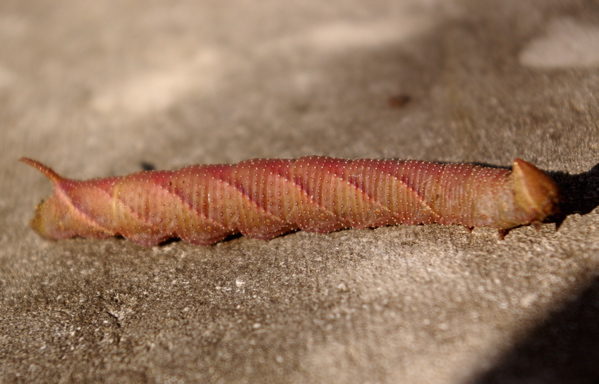
This is the larva of the Walnut sphinx, Amorpha juglandis, crawling about looking for a place to pupate. I've seen the adults around the garden, but we still don't have any walnuts or beeches. I'm betting on pecan as a host.
Label:
butterflies and moths,
hawkmoths,
Our Plot
06 August 2010
critters: Snowberry Clearwing Caterpillars

Isn't that just a beautiful caterpillar? I found this one and another munching away on our coral honeysuckle vine (Lonicera sempervirens) yesterday. First, I noticed the frass on the ground, and then looking up found the culprits.
This is really exciting! These are the larvae of the Snowberry Clearwing or Bumblebee hawkmoth (Hemaris diffinis), one of the most beautiful of the sphingid moths. It is one of the rare day flyers, and has evolved to mimic the bumblebee. Potential predators likely steer clear because they think they'll get stung.
I love the golden crown on the caterpillar's head. It's an easy way to recognize these.
The adults fly and reproduce two or maybe three times a year, and apparently the fall brood caterpillars might be brown instead of green. Here's a photo of an adult I snapped feeding on a Texas mountain laurel flower this past spring (iPhone photo, sorry).

So, if you plant a coral honeysuckle vine, you can help support these beautiful pollinators!
Label:
butterflies and moths,
hawkmoths,
Our Plot
21 July 2010
critters: Hawkmoths Munch the Datura

After I posted this about letting a big ol' Manduca sexta tobacco hornworm devour my tomato plant, I learned from a reader Paul that the hornworms - the larvae of hawkmoths in the family Sphingidae - love datura as well. He said that he picks them off his tomatoes and relocates them to datura. That makes sense, because datura and tomatoes are both nighshades in the family Solanaceae.
Solanaceae is big plant family that includes lots of common plants that we know, from tomato, potato, and chili pepper to datura, tobacco and petunia. So, if a hawkmoth evolves a way to handle the poisonous defenses of plants in the nightshade family, it would make sense that it might be able to eat others of the same family.
After Paul's comment, I kept an eye on my datura plants, of which I have 3. One day, I saw that one of the datura plants in front was being completely devoured by hawkmoth larvae. It probably had about 10 of them at minimum! And I'd identify these again as the common Manduca sexta because of the white stripes and the orange horn.
Here one is munching away.

Frass on leaves is a telltale sign of the critters and can help me find them (poop falls straight down, in other words).

This is what the plant looked like when they were finished. Completely stripped!

But the datura has sense grown new leaves and even supported another (smaller) crop of hornworms. Now, if the caterpillars would only give the plant a chance to produce enough energy to bloom. Then, when they become adult moths, they'll have some nectar to sip on.
It's cool that the datura can support both the larval and adult forms of this amazing insect.
Site plug: Here's a great website for identifying hawkmoth larvae in the Central Texas area. Oh, and my original photo of the Manduca sexta made an appearance on Central Texas Gardener. Thanks Linda!
Label:
butterflies and moths,
fauna,
hawkmoths,
Our Plot
10 June 2010
nature: Hawkmoths and the Tower

Today I had the privilege of going to the top of the University of Texas Tower building, an icon around these parts for both architectural and historical reasons. For the latter, it's open only by tour and special appointment.
As I was tooling around taking photos of the 360 degree view, I noticed that there were a ton of moth wings littering the observation deck. I assumed that the poor moths were attracted to the lights and banged themselves to death up there.

Then, I noticed that there were at least 6 live moths hanging around the walls up there of my favorite kind: the hawkmoth. These beauties, of the species Manduca quinquemaculatus, are huge. I'd say their wingspan is at least 6 inches. The gray patterns on their wings are gorgeous and they hide away the bright orange striped abdomen.


I was surprised to find them up so high, and also all on the north side of the building. If they flew low to the ground at night, I'd expect to find them gathered around all manor of lights around our buildings. But these were way up there, which either means they are particularly attracted to the VERY bright Tower lights or they fly way high up...or both.
At any rate, I turned around a corner and discovered one of two female grackles grabbing one of my moths off the wall, tearing its wings off and devouring the fat abdomen. A hefty meal for those birds, and an explanation for all of the abandoned wings along the floor. (Grackles, in my opinion, still have quite a bit of the wily T. rex in their genes. Just watch them hunt for a while.)

Anyway, neat. Nature on top of the city.
30 May 2010
veggies: Tomato Monsters
Some of you may recall my declaration last summer that I was done with tomatoes. I had had it up to here with the leaf-footed bugs sucking out my tomato juices and the squirrels carrying off and half eating my few ripe tomatoes. BUT, I'm a sucker. I couldn't resist the tomato plants at the garden center and went for it anyway. And what do I get? More bugs! Yay!

And speaking of, this morning I noticed the tell-tale signs of the presence of a tomato or tobacco hornworm - the larvae of the sphinx moth, Manduca sexta - tomato stems completely denuded and chewed to a nub. So I followed the trail down the stems and lo and behold: a hornworm!
Now, I do have a major love for sphinx moths, so this always puts me in a quandry.

Most folks would probably not hesitate to pluck that little f*cker off the plant and drown it in soapy water, squish it, or throw it over the fence. But I LOVE sphinx moths and their caterpillars. Look how exquisitely gorgeous this little creature is, all plump and green with eye-like spiracles passively inhaling my garden air. It's crocheted prolegs holding tight against the tomato stem. It's head and thorax held tight like a sphinx. The scary red horn on its end that's nothing more than ornament - not really prickly at all.
And the adult moths are like little fairies swirling around the gardens in the dark evenings, sipping nectar from plants like datura.
So, probably, since those other crappy bugs are eating my tomatoes and I'm unlikely to get many for myself anyway, I will leave my little hornworm to devour the tomato plant. He will get much bigger and much juicier. Perhaps he will become infested with little parasitoid wasps. Maybe a bird will find him for dinner. Or perhaps, he will leave some tomatoes for me.

And speaking of, this morning I noticed the tell-tale signs of the presence of a tomato or tobacco hornworm - the larvae of the sphinx moth, Manduca sexta - tomato stems completely denuded and chewed to a nub. So I followed the trail down the stems and lo and behold: a hornworm!
Now, I do have a major love for sphinx moths, so this always puts me in a quandry.

Most folks would probably not hesitate to pluck that little f*cker off the plant and drown it in soapy water, squish it, or throw it over the fence. But I LOVE sphinx moths and their caterpillars. Look how exquisitely gorgeous this little creature is, all plump and green with eye-like spiracles passively inhaling my garden air. It's crocheted prolegs holding tight against the tomato stem. It's head and thorax held tight like a sphinx. The scary red horn on its end that's nothing more than ornament - not really prickly at all.
And the adult moths are like little fairies swirling around the gardens in the dark evenings, sipping nectar from plants like datura.
So, probably, since those other crappy bugs are eating my tomatoes and I'm unlikely to get many for myself anyway, I will leave my little hornworm to devour the tomato plant. He will get much bigger and much juicier. Perhaps he will become infested with little parasitoid wasps. Maybe a bird will find him for dinner. Or perhaps, he will leave some tomatoes for me.
Label:
butterflies and moths,
fauna,
hawkmoths,
Our Plot
12 July 2009
Hawkmoth Macro
Our digital point-and-shoot gave up the ghost a little while ago, so I recently bought a new one. This hawkmoth, which I believe is a female Amorpha juglandis, gave me the perfect opportunity to test out the macro function.

I give it a major thumb's up. Not only does this simple camera (Canon Powershot A1000IS) take great close-ups, it also has a nice focus feature so that not everything in the frame is in focus at one time.

The caterpillars of this hawkmoth feed on walnut, hop hornbeam, hickory, alder and beech, none of which we have many of in my neighborhood. So maybe its feeding on something else too (pecan?). Neat critter. She was mellow enough that I could pick her up with ease.

I give it a major thumb's up. Not only does this simple camera (Canon Powershot A1000IS) take great close-ups, it also has a nice focus feature so that not everything in the frame is in focus at one time.

The caterpillars of this hawkmoth feed on walnut, hop hornbeam, hickory, alder and beech, none of which we have many of in my neighborhood. So maybe its feeding on something else too (pecan?). Neat critter. She was mellow enough that I could pick her up with ease.
Label:
butterflies and moths,
fauna,
hawkmoths
15 July 2008
Desert Willow Hawkmoth
Speaking of the desert willow (Chilopsis linearis), John's mom and I were admiring its pink and white, orchid-like blooms when I spotted this fellow:

Upon further inspection of the plant, I found 2 more. These are hawkmoths (if you read this blog regularly, you may know they are one of my all time favorite types of insects). This particular species is Manduca rustica. More on these moths here. These are truly beautiful creatures--check out those sleek blue-gray lines along the side of the caterpillar.
Like a zebra, it very obviously messes with my visual perception, camouflaging them from me and other predators. It's as if they evolved to match the shadows and leaf shape of the desert willow, but in fact, the desert willow and other plants in the begonia family are only some of their host plants.
Interestingly, the 3 larvae that I found are all clearly of different ages, ranging from just over an inch long to about 4 inches (this baby below is probably about to find a place to dig a hole in the ground and pupate).

I wonder if the larvae are from the same brood, but just hatched at different times? Are they from the same female, but she layed eggs on various nights? Or maybe their moms are completely different from each other?
I haven't seen the adults flying around, quietly exploring by garden. But I sure am happy they found it.

Upon further inspection of the plant, I found 2 more. These are hawkmoths (if you read this blog regularly, you may know they are one of my all time favorite types of insects). This particular species is Manduca rustica. More on these moths here. These are truly beautiful creatures--check out those sleek blue-gray lines along the side of the caterpillar.
Like a zebra, it very obviously messes with my visual perception, camouflaging them from me and other predators. It's as if they evolved to match the shadows and leaf shape of the desert willow, but in fact, the desert willow and other plants in the begonia family are only some of their host plants.
Interestingly, the 3 larvae that I found are all clearly of different ages, ranging from just over an inch long to about 4 inches (this baby below is probably about to find a place to dig a hole in the ground and pupate).

I wonder if the larvae are from the same brood, but just hatched at different times? Are they from the same female, but she layed eggs on various nights? Or maybe their moms are completely different from each other?
I haven't seen the adults flying around, quietly exploring by garden. But I sure am happy they found it.
Label:
butterflies and moths,
fauna,
hawkmoths,
Our Plot
17 July 2007
A Nessus Sphinx
This morning after a short rainstorm, I wandered down the driveway on my ritual Libby walk and found this Nessus sphinx moth, Amphion floridensis, resting under a red milkweed flower. (If you look closely, you can also see the requisite bright orange aphids that hang out on milkweed.)

Looks like these moths are fairly common throughout the Eastern U.S. and their caterpillars host on Virginia creeper, which we have growing all over our fences, through the back lawn and up our pecan tree. It turns a beautiful red in fall (which means December here).

Looks like these moths are fairly common throughout the Eastern U.S. and their caterpillars host on Virginia creeper, which we have growing all over our fences, through the back lawn and up our pecan tree. It turns a beautiful red in fall (which means December here).
Label:
butterflies and moths,
fauna,
hawkmoths
Subscribe to:
Posts (Atom)