

Showing posts with label butterflies and moths. Show all posts
Showing posts with label butterflies and moths. Show all posts
03 November 2013
12 October 2013
Tersa Sphinx
There was a Tersa sphinx moth (Xylophanes tersa tersa) hanging around the front light a couple of weeks ago. This is a new sphinx moth record for our property, bringing our total number to 10.

Label:
butterflies and moths,
fauna,
hawkmoths,
Our Plot

01 July 2013
Mothering Milkweeds for Monarchs
 |
| Asclepias tuberosa, or "butterfly weed," growing in Wisconsin. |
In the Midwest, butterfly weed, Asclepias tuberosa, is actually pretty widely used in garden. It is a prairie milkweed that is native all the way down to Texas. It's bright orange flowers (pictured above) and mounding form are perfect for flower gardens. And though butterfly weed is native to Texas, I rarely see it used here, or even growing anywhere on the roadside.
The one exception I've seen anywhere is actually right around the corner from me, where enterprising neighbors have a small patch of A. tuberosa they planted a few years ago. Here's a photo of one of them:

 |
| Young A. asperula planted in our neighborhood flower garden. I think I got this transplant from the LBJ Wildflower Center years ago. |
I've recently been learning why I don't see our native milkweeds in more gardens: they are extremely difficult to grow.
A couple of years ago, I bought some butterfly weed seeds from Native American Seed, and threw them in the ground. A couple actually sprouted and then they quickly died. I'm pretty sure it was snails.
Well, this year, I picked up one of NAM's new "Sustain the Migration" kits with three species of native milkweed seeds and everything you need to try to grow them. It all came in a nice package...

To cold stratify the seeds, I placed them in small ball jars with some vermiculite (in the package) and water and left them in the fridge for four weeks. (I'm trying to grow rattlesnake master too. It's another beautiful native that seems near impossible to grow.)


But now it is put up or shut up time. It's hotter than hell out there, and the worst time to plant anything, but these little suckers had to get in the ground. I planted them today. I will try to baby them through the summer, and hope that the snails, heat, dryness, and whatever else out there doesn't get to them first.
Why all this fuss anyway? Well, as I've said, the milkweeds are beautiful, but they are also extremely important to monarch butterflies, which host exclusively on milkweeds.
And the monarchs, they need our help. As most folks know, monarchs migrate south to Mexico to overwinter in pine forests there. This year the monarch populations had a record low in Mexico (Though they do fluctuate. Check that out here.)

 |
| Monarchs migrating to Mexico roosting for the night in West Texas. |
It's not clear exactly what is causing the decline in monarchs, as far as I can tell, but it is likely a number of things, from fire ants to climate change. There is a documented decrease in the milkweed. As more land is cleared and more herbicides are applied to roadsides and fields, the milkweed populations go down, and the monarch caterpillars then have fewer plants to grow on.
I've got a little personal mission to get more milkweed around these parts to help these incredible creatures out.
If you don't have the patience for all this milkweed mothering nonsense, but want to support monarchs, plant tropical milkweed. Asclepias curassavica is a native to Mexico that is widely planted around Texas, and it is a great host for butterflies. The monarchs and queens love it. It's a pretty and easy plant to grow, and available in most nurseries. It requires a good amount of water though, from my experience, so just beware of that. Also beware that it's often called "butterfly weed" in the nursery, but it isn't. That's A. tuberosa.
Here are a few links related to all this stuff that have more links for all your learning needs:
Milkweeds of Texas from the Texas Butterfly Ranch
Texas Monarch Watch
Milkweeds of Texas from Mike Quinn
In the meantime, I'm going to mother (or is it father?) my little weeds and hope for some growth and regrowth next spring...
Label:
butterflies and moths,
flora,
native plants,
Our Plot
14 April 2013
First Eastern Tent Caterpillar Siting (For Me) in Texas
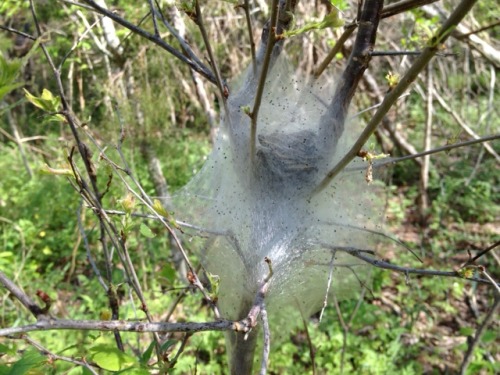
You know, you can probably count me among a small handful of freaky people that would be excited to find colonies of tent caterpillars (I've posted about forest tent caterpillars here). John and I went out to Bastrop a few weekends ago and went hiking at the Colorado River Refuge.
I was very excited to come across an area of the refuge that was supporting a pretty good population of Eastern tent caterpillars, Malacasoma americanum.
Growing up on the East coast, these were a common sight - and considered a pest by most - among the ornamental apple, plum and prunus trees. But I rather like them. They are a fascinating colonial species, not truly eusocial like the ants and bees, but social enough to build a protective shelter.
They also lay little pheromone trails along branches that their colony mates use to find the best patches of new leaves to munch on.
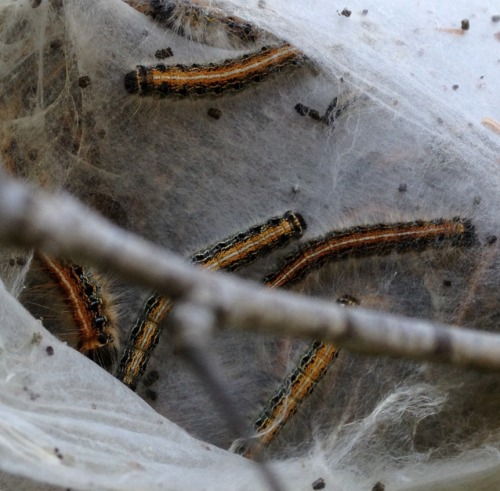
The silken shelter protects these caterpillars from parasitoids, kind of.
Parasitoids are a special class of insect that spend their larval stage as a parasite to another insect. These caterpillars, for example, are host to a number of wasp and fly species. What happens is that the adult female parasitoid finds the caterpillars and lays her eggs inside the caterpillar. The larvae of the parasitoid then grow by eating the caterpillar from the inside out. So, yea. Maggots eating you alive. Kinda gross, but also pretty awesome.
Anyhoo, theory goes that these webby nests protect the caterpillars from the marauding flies and wasps trying to bomb them with their eggs. The caterpillars forage at night to try to escape the parasitoids. The parasitoids obviously make it through the protection on a regular basis, or...they would've gone extinct a long time ago. That's the arms race that is evolution.
Birds can also break through the nests of course, and would be getting themselves quite a tasty treat if so.
There you have it. Eastern tent caterpillars in Bastrop, Texas. Cool!
Label:
butterflies and moths,
fauna,
The Outside World
18 March 2013
Pawpaw Sphinx Moth
Yesterday, I stood up from nestling some mulch between a few happily blooming sedges to look at a very loud mockingbird that was singing a gorgeous tune. I spied it on the power lines running along the back of the yard as it quickly took flight toward my head. Knowing mockingbirds, I figured I was in for a little territorial, protected peck on the head. But instead, it hovered gently above my headed gracefully flapping its wings as it pecked at the pecan trunk leaning above me. It seemed to find what it had come for and took off back toward its perch, only to drop the gray moth from its beak about halfway. The mockingbird could see what I couldn't see, and somehow from more than 30 feet away too.

It spied this very nicely camouflaged pawpaw sphinx, Dolba hyloeus, which surely blends in with the bark very well. This is a new hawkmoth (Sphingidae) species record for us at The Grackle, making this 9 sphingid species found in the garden.

We don't have paw paws this far west (oh but how I wish that we did!), so I'm guessing that the caterpillar of this moth feasted on possum haw (Ilex deciduosa) or yaupon (Ilex vomitoria) around the garden and neighborhood. I'll have to keep an eye out for the little green beasties this spring.
Anyway, happy for me and the moth, but too bad for the mockingbird. Thus is the Way.

It spied this very nicely camouflaged pawpaw sphinx, Dolba hyloeus, which surely blends in with the bark very well. This is a new hawkmoth (Sphingidae) species record for us at The Grackle, making this 9 sphingid species found in the garden.

We don't have paw paws this far west (oh but how I wish that we did!), so I'm guessing that the caterpillar of this moth feasted on possum haw (Ilex deciduosa) or yaupon (Ilex vomitoria) around the garden and neighborhood. I'll have to keep an eye out for the little green beasties this spring.
Anyway, happy for me and the moth, but too bad for the mockingbird. Thus is the Way.
Label:
butterflies and moths,
hawkmoths,
Our Plot,
pollinators
25 November 2012
Late Season Giant Swallowtail

I went to the Mexican oregano to tisk at its crunchy
brown death. Strange that after so many good years, it has decided to die back this year.
But among its branches and stems I found the beauty of
life. This giant swallowtail, Papilio cresphontes, freshly emerged to this world and perfect in
every way. Too cold this morning to move, the butterfly waited for the warmth of the sun
to fly.
Label:
butterflies and moths,
fauna,
Our Plot
07 October 2012
Giant Leopard Moth

Here it is, the giant leopard moth (Hypercompe scribonia), hiding from the rain last weekend under the lip of our recycling container. Beautiful.

Label:
butterflies and moths,
fauna,
Our Plot
30 July 2012
Why My Hood Needs More Coral Honeysuckle

We have but one coral honeysuckle vine, Lonicera sempervirens, in the garden. About a month ago, there was a snowberry clearwing moth laying her eggs all over it, and over the past months the resulting caterpillars have almost completed devoured the vine. The results can be seen above. Nary a leaf is left!
Those caterpillars also recently retreated into their little crypts in the ground and pupated. They are now emerging quickly as adults. Here is one that is just drying its wings before taking a first flight.

What does this mean? We need more coral honeysuckle vines folks! Look at the beautiful moth that these plants provide for. I may try to figure out how to integrate a couple more into my garden, but space is limited. This is a great example of how we can collectively help wildlife by creating larger ecosystems for them across our neighborhoods in effort to replace little habitat islands with a larger patchwork to replace what is now missing.
Label:
butterflies and moths,
fauna,
flora,
hawkmoths,
Our Plot
07 July 2012
Clearwing Caught in the Act

Caught this snowberry clearwing (Hemaris diffinis) female hawkmoth ovipositing on the coral honeysuckle. After she (or multiple she's) were finished, there were emerald spherical eggs all over the leaves of this vine. Now, the young caterpillars are munch munching away, hopefully not to too much detriment to the plant. I believe it will recover just fine...it's a native adapted to this kind of thing right?
Here are some posts on the clearwings.
Label:
butterflies and moths,
fauna,
hawkmoths,
Our Plot
09 June 2012
Hawkmoth Haven
If you follow this blog at all, you know I'm a sucker for hawkmoths. Don't know what it is, but I just love these animals. The larvae are fascinating and the adults and beautiful.
This week, I've discovered three species of hawkmoth larvae munching on our plants, one of them is new to me.
There's the snowberry clearwing or bumblebee moth, Hemaris diffinis, which loves the coral honeysuckle vine. I've spied several on the vine this year, and many in the past as well.

And the tomatillo plant is not immune to ways of the tobacco hornworm, Manduca sexta. This fat sucker is manging away on the tomatillo. Not surprising, since it's in the nightshade family. This is also not the first Manduca sexta at the Grackle. Look at the way it rears up like a sphinx.

But this next one is a new species record for the yard! This is the larvae of the Plebian sphinx, Paratrea plebeja.

I've been trying to get rid of some trumpet creeper, Campsis radicans, that grows along the back wall of the garage since we moved here 6 years ago. I pull it up, but it always comes back. This year, I decided that the trumpet creeper won, and I'd just enjoy it. But when I went out this morning, I discovered that it was completely denuded! I knew it must've been caterpillars but it took me a while to find these tiny guys and gals. They are only about 1-2 inches long. I counted about 4 or 5 of them.
I was also able to snap a couple of photos of a white-lined sphinx moth adult nectaring on the Mexican oregano.


This week, I've discovered three species of hawkmoth larvae munching on our plants, one of them is new to me.
There's the snowberry clearwing or bumblebee moth, Hemaris diffinis, which loves the coral honeysuckle vine. I've spied several on the vine this year, and many in the past as well.

And the tomatillo plant is not immune to ways of the tobacco hornworm, Manduca sexta. This fat sucker is manging away on the tomatillo. Not surprising, since it's in the nightshade family. This is also not the first Manduca sexta at the Grackle. Look at the way it rears up like a sphinx.

But this next one is a new species record for the yard! This is the larvae of the Plebian sphinx, Paratrea plebeja.

I've been trying to get rid of some trumpet creeper, Campsis radicans, that grows along the back wall of the garage since we moved here 6 years ago. I pull it up, but it always comes back. This year, I decided that the trumpet creeper won, and I'd just enjoy it. But when I went out this morning, I discovered that it was completely denuded! I knew it must've been caterpillars but it took me a while to find these tiny guys and gals. They are only about 1-2 inches long. I counted about 4 or 5 of them.
I was also able to snap a couple of photos of a white-lined sphinx moth adult nectaring on the Mexican oregano.


Label:
butterflies and moths,
fauna,
hawkmoths,
Our Plot
06 May 2012
White Lined Sphinx

Discovered this white lined sphinx moth, Hyles lineata, last night while sitting beneath the giant full moon and watching the lightening move in from the west. Rain! I feel bad for pulling this moth away from its usual night time rounds with the string lights, but it was fun to get a chance to see it anyway.
Label:
butterflies and moths,
hawkmoths,
Our Plot
01 April 2012
Forester

The forester moth that likely goes with the caterpillars munching on my grape and virginia creeper vines. I snapped this photo, however, down at the greenbelt.
Label:
butterflies and moths,
fauna
25 March 2012
Spring Caterpillars
Spring is the time for many things. It's a real big time for caterpillars, especially those that host on trees and other woody plants. A quiet walk through the neighborhood or the woods this time of year
in Central Texas reveals the pitter-patter of caterpillar droppings
(frass) falling all over the place.
Gross? No way. I think it's amazing.
It's a good time for caterpillars because leaves are young, tender and just emerging. Most mature leaves are full of defenses, such as waxy coats and chemicals. For an example, just think of the difference between a newly emerging live oak leaf, all bright green and floppy, and one that is about 2 months old, which is dark green and waxy.
Tiny first instar caterpillars have small mouthparts and can't yet handle thick, heavily defended leaves. So many butterflies and moths time their egg-laying to coincide in various ways with the emergence of the new leaves in spring.
Part of having a garden for wildlife is accepting that said wildlife will be eating your garden. For example, I've discovered a new caterpillar that is munching its way through our beautiful stand of heartleaf skullcap (Scutellaria ovata).

I haven't been able to figure out what this one is yet.
These beautiful caterpillars are also new to me this year. They are munching away on our grapevine and all over the Virginia creeper. I've never seen them before.

A couple of weeks ago I kept seeing this beautiful black, day-flying moth with white and orange spots. I tried my damnedest to snap a photo of it, but it flitted away every time.
With a bit of research, I discovered that these caterpillars likely belong to that moth. I think they are the eight-spotted forester, Alypia octomaculata, and they are having a banner year. (It's possible it is another species of Alypia, but I'll go with this one for now). The caterpillars are all over our grape and Virginia creeper. Since I want the grape, I'm transplanting the moth caterpillars onto the Virginia creeper, which we have plenty of. The adult moths are beautiful, and I'm happy to have them around.
 I was über-excited on a hike this weekend at the Barton Creek Greenbelt to discover these forest tent caterpillars, Malacosoma disstria. Most people consider these pests, but I think they are completely fascinating, particularly their group foraging behavior.
It's possible these are hosting on a blackgum, Nyssa sylvatica. (I don't know my trees super well and should've collected leaves for later identification.)
These caterpillars move in lines down branches to eat young leaves during the day. Unlike the eastern tent caterpillars, they don't form huge communal tents from silk. Instead, they may rest on a group-built silky mat on a branch at night.
In northern Wisconsin, these caterpillars have enormous outbreaks and drive people crazy. Here in Central Texas, they seem less of a big deal. I didn't even know we had any Malacosoma species here until I found these.
Gross? No way. I think it's amazing.
It's a good time for caterpillars because leaves are young, tender and just emerging. Most mature leaves are full of defenses, such as waxy coats and chemicals. For an example, just think of the difference between a newly emerging live oak leaf, all bright green and floppy, and one that is about 2 months old, which is dark green and waxy.
Tiny first instar caterpillars have small mouthparts and can't yet handle thick, heavily defended leaves. So many butterflies and moths time their egg-laying to coincide in various ways with the emergence of the new leaves in spring.
Part of having a garden for wildlife is accepting that said wildlife will be eating your garden. For example, I've discovered a new caterpillar that is munching its way through our beautiful stand of heartleaf skullcap (Scutellaria ovata).

I haven't been able to figure out what this one is yet.
These beautiful caterpillars are also new to me this year. They are munching away on our grapevine and all over the Virginia creeper. I've never seen them before.

A couple of weeks ago I kept seeing this beautiful black, day-flying moth with white and orange spots. I tried my damnedest to snap a photo of it, but it flitted away every time.
With a bit of research, I discovered that these caterpillars likely belong to that moth. I think they are the eight-spotted forester, Alypia octomaculata, and they are having a banner year. (It's possible it is another species of Alypia, but I'll go with this one for now). The caterpillars are all over our grape and Virginia creeper. Since I want the grape, I'm transplanting the moth caterpillars onto the Virginia creeper, which we have plenty of. The adult moths are beautiful, and I'm happy to have them around.

It's possible these are hosting on a blackgum, Nyssa sylvatica. (I don't know my trees super well and should've collected leaves for later identification.)
These caterpillars move in lines down branches to eat young leaves during the day. Unlike the eastern tent caterpillars, they don't form huge communal tents from silk. Instead, they may rest on a group-built silky mat on a branch at night.
In northern Wisconsin, these caterpillars have enormous outbreaks and drive people crazy. Here in Central Texas, they seem less of a big deal. I didn't even know we had any Malacosoma species here until I found these.
Label:
butterflies and moths,
fauna,
Our Plot,
The Outside World
11 December 2011
Winter Walnut Sphinx Larvae

We found this Walnut sphinx (Amorpha juglandis) larvae slowly crawling across the pavement this weekend - a strange sight to see in the December. I grabbed it and placed it on the soil in our garden, where it immediately began to find its way beneath the mulch and soil. This is a green morph. I've previously documented the red-brown morph in the garden. We have none of this moth's documented host plants anywhere around the hood, so I'm guessing it likes to munch on the pecans...closely related to walnuts...
Label:
butterflies and moths,
fauna,
hawkmoths,
Our Plot
31 October 2011
Mariposa de la Muerta
On the morning of the Halloween, during this time of Dia de los Muertos, look at the beautiful moth that appeared before us hiding under a bridge on San Antonio's River Walk:

The Black Witch (Ascalapha odorata) or the Mariposa de la Muerta. This is our largest moth north of Mexico, with a wingspan of about 6 or 7 inches. Look how it stacks up against my large hand:

Learn more about this fascinating lepidoptera on Mike Quinn's Texas Entomology. Happy Halloween! Mwa-ha-ha-ha-ha...

The Black Witch (Ascalapha odorata) or the Mariposa de la Muerta. This is our largest moth north of Mexico, with a wingspan of about 6 or 7 inches. Look how it stacks up against my large hand:

Learn more about this fascinating lepidoptera on Mike Quinn's Texas Entomology. Happy Halloween! Mwa-ha-ha-ha-ha...
Label:
butterflies and moths,
fauna,
The Outside World
13 October 2011
Monarch Migration in West Texas

The monarch butterflies were on the move this past weekend (Oct 8-9, 2011) across Texas. It was everything we could do to not kill hundreds of them as they flitted southward to Mexico and we sped down I-10 to Balmorhea State Park. (It's really tragic to kill such a beautiful creature that has been flying so hard and so long across the vast plains of this country, trying its best to get to Mexico.)
When we arrived, we found ourselves in a magical enchanted land, with thousands of monarchs flying all around us, finding roosts in the trees of the state park on a windy West Texas day.


Label:
butterflies and moths,
fauna,
The Outside World,
travel
15 July 2011
Milkweed Mania
Ever since my visit northward, I'm completely obsessed with milkweeds. There are so many species of these important plants native to the U.S. and they are really all very beautiful. Here in Central Texas, we see a lot of antelope horn (Asclepius asperula) and tropical milkweed (Asclepius curassavica), which is native to Mexico.
But there are many others that are common (or used to be common) in the state. Here are three of those that I photographed in Wisconsin at Riveredge Nature Center.
The common "weedy" milkweed, Asclepius syriaca.

This one is really beautiful and grows in large spreading clumps in ditches all over the place up there. Here it is also growing in a prairie restoration. Look at those beautiful pinkish pom-pom flowers. This milkweed exudes a great floral scent as well.

I'd like to plant some of the common milkweed real bad, but am afraid of its potential weediness. It's got a great upright form and beautiful flowers.
Here's the bright and bossy butterflyweed, Asclepius tuberosa.

It's really the star of a meadow or prairie garden and found very commonly in the nursery trade in the northern part of the country.
And here is swamp milkweed (Asclepius incarnata), which is just about to bloom. This one gets tall and likes to have its feet wet. It also looks a bit more like our tropical milkweed in form.

One of the greatest things about the milkweeds is that they support a large number of insects, despite the fact that they exude a milky, white sap that is toxic. There are many insects that have evolved to be able to handle those defenses, and in fact some, like the famous monarch butterfly, sequester the toxin in their bodies when they are leaf-munching larvae to protect from bird predators when they are adult butterflies. Almost all of the milkweed-associated species that I've seen are colored orange and black during some part of their life stage to ward away the predators.
If it's the right time of year, it just takes a bit of poking around the milkweed (especially common milkweed) to find a monarch larvae. Just look for the signs of munching or little black frass pellets collecting on leaves.

This particular caterpillar will probably become an adult in mid-August sometime. Though that generation may have time for one more generation up in the north, I waiger this is the generation of adults that will make the long migration back to Mexico in the fall. Maybe the butterfly that emerges from this particular larva will flit past The Grackle garden in October...
Here's a site with photos of the Texas milkweeds.
But there are many others that are common (or used to be common) in the state. Here are three of those that I photographed in Wisconsin at Riveredge Nature Center.
The common "weedy" milkweed, Asclepius syriaca.

This one is really beautiful and grows in large spreading clumps in ditches all over the place up there. Here it is also growing in a prairie restoration. Look at those beautiful pinkish pom-pom flowers. This milkweed exudes a great floral scent as well.

I'd like to plant some of the common milkweed real bad, but am afraid of its potential weediness. It's got a great upright form and beautiful flowers.
Here's the bright and bossy butterflyweed, Asclepius tuberosa.

It's really the star of a meadow or prairie garden and found very commonly in the nursery trade in the northern part of the country.
And here is swamp milkweed (Asclepius incarnata), which is just about to bloom. This one gets tall and likes to have its feet wet. It also looks a bit more like our tropical milkweed in form.

One of the greatest things about the milkweeds is that they support a large number of insects, despite the fact that they exude a milky, white sap that is toxic. There are many insects that have evolved to be able to handle those defenses, and in fact some, like the famous monarch butterfly, sequester the toxin in their bodies when they are leaf-munching larvae to protect from bird predators when they are adult butterflies. Almost all of the milkweed-associated species that I've seen are colored orange and black during some part of their life stage to ward away the predators.
If it's the right time of year, it just takes a bit of poking around the milkweed (especially common milkweed) to find a monarch larvae. Just look for the signs of munching or little black frass pellets collecting on leaves.

This particular caterpillar will probably become an adult in mid-August sometime. Though that generation may have time for one more generation up in the north, I waiger this is the generation of adults that will make the long migration back to Mexico in the fall. Maybe the butterfly that emerges from this particular larva will flit past The Grackle garden in October...
Here's a site with photos of the Texas milkweeds.
Label:
butterflies and moths,
flora
01 March 2011
Great Purple Hairstreak

I found this lovely Great Purple Hairstreak, Atlides halesus, resting in the middle of the street. I imagine she emerged a bit early and it just wasn't quite warm enough for her. I say "she" because her abdomen looked plump with eggs. She was docile enough that I could carry her home with me and place her on this white background.
If you have mistletoe in your area, you probably have these beautiful butterflies. It's their sole larval food source.
The upper sides of the butterfly's wings flash bright blue-purple in the sun. And they wave those little squiggly things on the back of their wings together so that it looks like a head with antennae. It's pretty convincing, even for the human eye. If a bird were to chomp at the hind wings, the butterfly loses very little but gains an opportunity to fly away free.
Label:
butterflies and moths,
fauna,
Our Plot
01 November 2010
critters: Bumblebee Hawkmoth

Finally snapped a good photo of the bumblebee hawkmoth, Hemaris diffinis. This one was resting peacefully on the okra before it revved up its tiny little clear wings and took off. It's such a fantastic mimic of the bumblebee. Strange, because I almost never see bumblebees in Austin. In fact, maybe never?
These beautiful creatures have been munching on the coral honeysuckle, which I documented here.
Label:
butterflies and moths,
fauna,
hawkmoths,
Our Plot
21 October 2010
critters: Amorpha juglanis larva
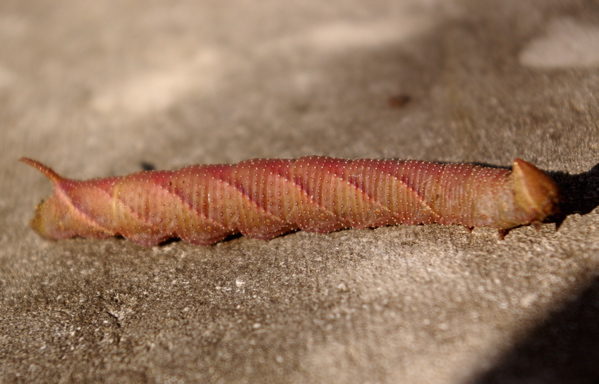
This is the larva of the Walnut sphinx, Amorpha juglandis, crawling about looking for a place to pupate. I've seen the adults around the garden, but we still don't have any walnuts or beeches. I'm betting on pecan as a host.
Label:
butterflies and moths,
hawkmoths,
Our Plot
Subscribe to:
Posts (Atom)