Showing posts with label fauna. Show all posts

21 September 2014

Wasps and Rakes

I'm really glad that I found these before they found me.

Do you see them? Look close...


Gardening often has it's surprises, and wasps are one of the more common. Many folks are apt to pull out the bug spray and destroy the nests, but I encourage everyone to think twice.

Social wasps, like these Polistes paper wasps nesting in my American beautyberry, are important parts of the garden ecosystem. They are excellent predators, and particularly like feeding caterpillars and spiders to their developing young. They are also pollinators, and you can often find them rooting around inside flowers for pollen and nectar.

Of course, wasps can build nests in dangerous places and those need to be dealt with from time to time. I try to keep an eye out for the queens when they start  building their initial "seed" nests in the spring. Before the nest gets large and any of the workers grow, they are pretty vulnerable, and the queens aren't very aggressive either (generally). You can basically just sweep the nest away without harming her (or while she's out foraging), and she'll find another spot.

Just beware the hidden nests hanging under a leaf or on a branch in your garden!

Wasps are beautiful, complex creatures.

All this came about while we were cleaning things up a bit in the garden prepping for Fall. Weeding after these rains is super easy and good to take advantage of. It's a great time to pull all the little weeds (mostly straggler daisy on our property) growing in the pea gravel.


12 October 2013

Tersa Sphinx

There was a Tersa sphinx moth (Xylophanes tersa tersa) hanging around the front light a couple of weeks ago. This is a new sphinx moth record for our property, bringing our total number to 10.


14 April 2013

First Eastern Tent Caterpillar Siting (For Me) in Texas


You know, you can probably count me among a small handful of freaky people that would be excited to find colonies of tent caterpillars (I've posted about forest tent caterpillars here). John and I went out to Bastrop a few weekends ago and went hiking at the Colorado River Refuge.

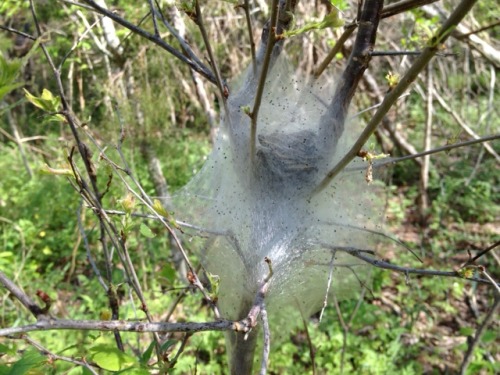
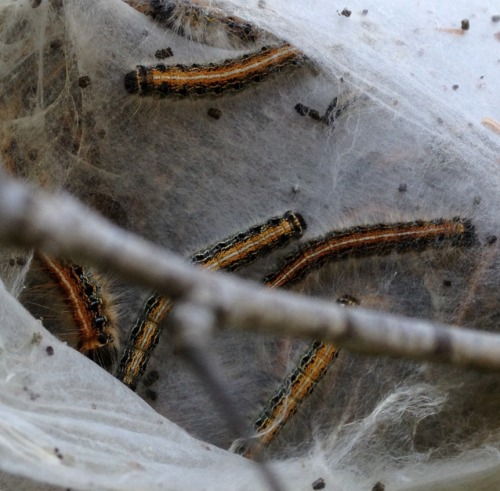
I was very excited to come across an area of the refuge that was supporting a pretty good population of Eastern tent caterpillars, Malacasoma americanum.

Growing up on the East coast, these were a common sight - and considered a pest by most - among the ornamental apple, plum and prunus trees. But I rather like them. They are a fascinating colonial species, not truly eusocial like the ants and bees, but social enough to build a protective shelter.

They also lay little pheromone trails along branches that their colony mates use to find the best patches of new leaves to munch on.


The silken shelter protects these caterpillars from parasitoids, kind of.

Parasitoids are a special class of insect that spend their larval stage as a parasite to another insect. These caterpillars, for example, are host to a number of wasp and fly species. What happens is that the adult female parasitoid finds the caterpillars and lays her eggs inside the caterpillar. The larvae of the parasitoid then grow by eating the caterpillar from the inside out. So, yea. Maggots eating you alive. Kinda gross, but also pretty awesome.

Anyhoo, theory goes that these webby nests protect the caterpillars from the marauding flies and wasps trying to bomb them with their eggs. The caterpillars forage at night to try to escape the parasitoids. The parasitoids obviously make it through the protection on a regular basis, or...they would've gone extinct a long time ago. That's the arms race that is evolution.

Birds can also break through the nests of course, and would be getting themselves quite a tasty treat if so.

There you have it. Eastern tent caterpillars in Bastrop, Texas. Cool!

25 November 2012

Late Season Giant Swallowtail


I went to the Mexican oregano to tisk at its crunchy brown death. Strange that after so many good years, it has decided to die back this year. 
 
But among its branches and stems I found the beauty of life. This giant swallowtail, Papilio cresphontes, freshly emerged to this world and perfect in every way. Too cold this morning to move, the butterfly waited for the warmth of the sun to fly. 
 

07 October 2012

Giant Leopard Moth


Here it is, the giant leopard moth (Hypercompe scribonia), hiding from the rain last weekend under the lip of our recycling container. Beautiful.

The fuzzy black caterpillars of this moth are constant companions in the garden. I've seen bits of wings of adults, but never seen one living and breathing through its spiracles.

15 September 2012

Shedding Skin


I've been waiting and wondering when the Texas persimmon in the front yard would get old enough to start shedding its bark and to begin getting its characteristic pale gray-streaked bark. When mature, their trunks look much like crepe myrtles.

While cleaning up a bit today, I discovered that it started! I've been checking for six years, so this was a really cool find. We all change and age, shedding our skins as we grow. Like Texas persimmons, may we all feel that those changes make us more beautiful.

While poking around in the turk's cap, I found a sweet little anolis that was shedding its skin too.


The little guy was very vulnerable actually, not really able to move. I was very careful to not disturb him as he preened and took care of himself to remove his old shell. It felt like I was interrupting a very intimate moment.

Lizards, snakes and other animals go through great transitions and changes such as this. Shedding skin and fur. When butterflies and moths emerge from their pupal phase, they stretch and dry their wings. It's a very vulnerable stage for them.

Humans, too, are vulnerable during times of transition, almost fragile. Life can change through external forces - like losing a loved one, gaining a loved one, moving to a new city - or by internal forces, as our minds and emotions change through age. And we, just as many other animals, require a time, space and gentleness to change.

30 July 2012

Why My Hood Needs More Coral Honeysuckle


We have but one coral honeysuckle vine, Lonicera sempervirens, in the garden. About a month ago, there was a snowberry clearwing moth laying her eggs all over it, and over the past months the resulting caterpillars have almost completed devoured the vine. The results can be seen above. Nary a leaf is left!

Those caterpillars also recently retreated into their little crypts in the ground and pupated. They are now emerging quickly as adults. Here is one that is just drying its wings before taking a first flight.

Within hours, there were females laying eggs again on the very few remaining leafs left on our vine. Those caterpillars will most certainly not make it to adulthood. There are simply not enough leaves left to feed even one caterpillar.

What does this mean? We need more coral honeysuckle vines folks! Look at the beautiful moth that these plants provide for. I may try to figure out how to integrate a couple more into my garden, but space is limited. This is a great example of how we can collectively help wildlife by creating larger ecosystems for them across our neighborhoods in effort to replace little habitat islands with a larger patchwork to replace what is now missing.

07 July 2012

Clearwing Caught in the Act


Caught this snowberry clearwing (Hemaris diffinis) female hawkmoth ovipositing on the coral honeysuckle. After she (or multiple she's) were finished, there were emerald spherical eggs all over the leaves of this vine. Now, the young caterpillars are munch munching away, hopefully not to too much detriment to the plant. I believe it will recover just fine...it's a native adapted to this kind of thing right?

Here are some posts on the clearwings.

25 June 2012

Mountain Inspiration


Hiking in Colorado, I recently came across this wonderful planting scheme, planted by Ma Nature herself. It felt to me like one of those things I should learn from. There's a great mix of low growing groundcovers, such as sedge, with a couple of vertical accents, all backed by the woods themselves. This is good inspiration for a woodland opening type of planting design.

The sedges:


The low growing perennials:


The vertical accents:


14 June 2012

More Cacti from the Davis Mountains


And some javelinas, plotting to later take our garbage, give Bodi a run for his money, and almost make me have a heart attack.


12 June 2012

Balm for Bees


This pretty little native bee was making work of this horsemint, Monarda citriodora, also known as lemon beebalm for obvious reasons. It has collected a ton of bright yellow pollen in its pollen basket, but I'm thinking that pollen is not from the horsemint.

See that white patch on the bee's thorax? That's a fine dusting of pollen that is being deposited on the bee by the stamens in the horsemint flowers. Both the pistil and stamen are at the top of the flower, perfectly evolved to aid in pollination when a hungry bee goes deep into the flower for sweet, lemony nectar. The bee gets dusted with pollen and then flies it over to a pistil waiting in the next flower.

09 June 2012

Hawkmoth Haven

If you follow this blog at all, you know I'm a sucker for hawkmoths. Don't know what it is, but I just love these animals. The larvae are fascinating and the adults and beautiful.

This week, I've discovered three species of hawkmoth larvae munching on our plants, one of them is new to me.

There's the snowberry clearwing or bumblebee moth, Hemaris diffinis, which loves the coral honeysuckle vine. I've spied several on the vine this year, and many in the past as well.


And the tomatillo plant is not immune to ways of the tobacco hornworm, Manduca sexta. This fat sucker is manging away on the tomatillo. Not surprising, since it's in the nightshade family. This is also not the first Manduca sexta at the Grackle. Look at the way it rears up like a sphinx.


But this next one is a new species record for the yard! This is the larvae of the Plebian sphinx, Paratrea plebeja.


I've been trying to get rid of some trumpet creeper, Campsis radicans, that grows along the back wall of the garage since we moved here 6 years ago. I pull it up, but it always comes back. This year, I decided that the trumpet creeper won, and I'd just enjoy it. But when I went out this morning, I discovered that it was completely denuded! I knew it must've been caterpillars but it took me a while to find these tiny guys and gals. They are only about 1-2 inches long. I counted about 4 or 5 of them.

I was also able to snap a couple of photos of a white-lined sphinx moth adult nectaring on the Mexican oregano.


04 June 2012

Megaphasma


Ok, I know this is yet another photo that doesn't come from my garden, but I have to share it anyway. I came across this giant walkingstick, Megaphasma dentricus, down at the greenbelt this weekend. It's giant! It's mega! What a fascinating creature.


The poor thing had lost one of its legs at some point, but perhaps that is a small price to pay for avoiding predation or whatever led to that. This species holds the record as the longest insect in the U.S. From head to tail, this one is about 6.5 inches. Like I said, mega.

29 April 2012

The Meandering Path

The Barton Creek Greenbelt is gorgeous right now, full of wildflowers like Indian blanket, Engelmann's daisy, white poppy, verbena, winecup and blackfoot daisy. Meandering paths, like the one pictured above, are idyllic right now.

Indian blanket, Gaillardia pulchella, is particularly dominant in this field.


Here's a cool critter that I found on an elm near the creek bank (actually in a tree right next to the one where we found the forest tent caterpillars a month or so ago).

This may look like a giant white caterpillar, which is what I thought it was. But it's actually the caterpillar-like larvae of the Elm sawfly, Cimbex americana. These beautiful larvae, which are about 2 inches long, were all over the elm. Sawfly's are primitive hymenopterans, related to the ants, wasps and bees. Sawflies are not like their more social cousins, which generally raise their young in brood cells, such as the cells in honey bee hives and wasp nests, or brood chambers in an ant hill.

Instead, sawfly larvae look and behave much like the caterpillars of lepidopterans (butterflies and moths). They can be major forest pests, and the larvae of many species live socially in large groups much like tent caterpillars. They can devour tree leaves very quickly in such large groups. Fascinating creatures.

Apparently, it is characteristic for them to coil into this shape when at rest. I love spirals. They are everywhere you look.


Here's another lovely critter that was swimming with me at the waterfall. Can you see it? This photo is like a puzzle, but if you look close, you'll see the well camouflaged southern leopard frog, Rana utricularia.


17 April 2012

Leafcutter Ants and Forester Moths

Our Virginia creeper vine is being completely stripped bare this year by the forester moth caterpillars. I've never seen so many of these caterpillars around. They are having a huge population explosion. As the little larvae munch away on the creeper that grows up the pecan tree hanging over the garage, they've been leaving their little black droppings (so called "frass") all over the driveway.

Yesterday, John noticed that our local neighborhood leaf cutter ants, Atta texana, were swarming all over the drive. Upon closer inspection, I discovered that they were collecting all of the forester caterpillar frass, pulling it into lines, dropping it into larger piles, and most likely taking it back to the colony to use for fungus fodder. Crazy!

The leaf cutter ants worry me from time to time. We don't have deer or rabbits; I guess our herbivores are these critters. The colony, or colonies, have been getting much larger and they are clearly expanding their foraging territory. Unlike plants labeled "deer resistant" at the nursery, there are none labeled "ant resistant." I do know they love the Mexican plum from past experience, and I'll be keeping an eye on that. Once they find a target, they are very voracious...

01 April 2012

Forester


The forester moth that likely goes with the caterpillars munching on my grape and virginia creeper vines. I snapped this photo, however, down at the greenbelt.

25 March 2012

Spring Caterpillars

Spring is the time for many things. It's a real big time for caterpillars, especially those that host on trees and other woody plants. A quiet walk through the neighborhood or the woods this time of year in Central Texas reveals the pitter-patter of caterpillar droppings (frass) falling all over the place.

Gross? No way. I think it's amazing.

It's a good time for caterpillars because leaves are young, tender and just emerging. Most mature leaves are full of defenses, such as waxy coats and chemicals. For an example, just think of the difference between a newly emerging live oak leaf, all bright green and floppy, and one that is about 2 months old, which is dark green and waxy.

Tiny first instar caterpillars have small mouthparts and can't yet handle thick, heavily defended leaves. So many butterflies and moths time their egg-laying to coincide in various ways with the emergence of the new leaves in spring.

Part of having a garden for wildlife is accepting that said wildlife will be eating your garden. For example, I've discovered a new caterpillar that is munching its way through our beautiful stand of heartleaf skullcap (Scutellaria ovata).


I haven't been able to figure out what this one is yet.

These beautiful caterpillars are also new to me this year. They are munching away on our grapevine and all over the Virginia creeper. I've never seen them before.


A couple of weeks ago I kept seeing this beautiful black, day-flying moth with white and orange spots. I tried my damnedest to snap a photo of it, but it flitted away every time.

With a bit of research, I discovered that these caterpillars likely belong to that moth. I think they are  the eight-spotted forester, Alypia octomaculata, and they are having a banner year. (It's possible it is another species of Alypia, but I'll go with this one for now). The caterpillars are all over our grape and Virginia creeper. Since I want the grape, I'm transplanting the moth caterpillars onto the Virginia creeper, which we have plenty of. The adult moths are beautiful, and I'm happy to have them around.

I was über-excited on a hike this weekend at the Barton Creek Greenbelt to discover these forest tent caterpillars, Malacosoma disstria. Most people consider these pests, but I think they are completely fascinating, particularly their group foraging behavior.

It's possible these are hosting on a blackgum, Nyssa sylvatica. (I don't know my trees super well and should've collected leaves for later identification.)

These caterpillars move in lines down branches to eat young leaves during the day. Unlike the eastern tent caterpillars, they don't form huge communal tents from silk. Instead, they may rest on a group-built silky mat on a branch at night.

In northern Wisconsin, these caterpillars have enormous outbreaks and drive people crazy. Here in Central Texas, they seem less of a big deal. I didn't even know we had any Malacosoma species here until I found these.


19 February 2012

Bring On the Mason Bees


Just hung this aesthetically pleasing mason bee house that was a Christmas gift from mom. (You can pick this up from Gardener's Supply in case you are wondering.) This is the second bee house in the garden for attracting native bees. I can't wait to see who takes up residence. Clearly this anolis lizard is staking out his place too. Have you ever seen those videos of snakes that sit at the mouths of caves and pick off exiting bats? That's what I'm picturing here, but much cuter somehow. Nature rocks.

16 January 2012

Being a Better Naturalist


One of my goals for this new year is to try and be a better naturalist - to better document and observe the nature around me. This blog has long been an effort at that, but I've actually never been good at keeping deeper records of the plants, birds, insects and other animals around me. A good naturalist would have documents of sitings with dates and other important information, like weather. I'm going to try and work may way to that little by little.

To that end, I just compiled some master lists of the plants, butterflies and moths, birds, and reptiles, amphibians and mammals found at the Grackle. I've certainly forgotten things, so keeping this updated will be a new challenge for me. The butterfly and moth list, in particular, is very small compared to all the species I know that we have.

On the plant front in particular, it was an interesting exercise to write them all down and especially to categorize what is native and what isn't. One of the little challenges with that is that while we consider some things "Texas natives," they aren't really native to this area (for example, desert willow is widely used in gardens in Austin, but is a native of in West Texas.)

One of my goals is to have more plants from the Blackland prairie in the garden, and making this list made me realize how few we have to date. In particular, I'd like to have more native Blackland prairie grasses. As a next step, I'm going to separate those plants out in my lists and then think about how to get more Blackland prairie plants here in the garden.