Showing posts with label flora. Show all posts

26 November 2015

Thanksgiving Tree

Who needs a Christmas tree when you can have a Thanksgiving tree? 

I'm so thrilled to welcome a new chinquapin oak to our back garden, which replaces the xylosma that I removed a few weeks ago. The oak is perfect, and I can't wait for it to grow larger and provide us with shade from the hot summer sun.

Oaks are some of our most important trees for wildlife. They are hosts for tons of species of bugs, which means they are great sources of food for birds. The acorns are important for a lot of species too, such as blue jays. Even early settlers and Native Americans ground the acorns into flour. 

Great trees.

An added bonus is that this tree already looks like it belongs here in our deep black clay, near our creek that's in the Colorado River watershed. The xylosma never did. Something about it just seemed out of place, even though it was a nice specimen of a tree. The chinquapin looks at home. 

I'm thankful for this tree. Yes indeedy.


15 November 2015

Getting Rid of an Unwanted Guest


Years ago, I planted a small Asian xylosma tree that I purchased on a whim from the Natural Gardener (they have since removed them from their stock). At once, I felt some trepidation about planting it, but desire won over. As the years have gone by, the xylosma has grown into a lovely evergreen multitrunked tree that anchors the patio garden.

But still, I've often wondered if it was the correct thing to plant, and pondered as much here on this blog.

When I bought the tree, I was under the impression that it was "sterile." I should've done more research. I recently discovered that it is not, in fact, sterile. These berries... 


Turn into new little xylosma trees...


I knew it was germinating from seed, because from seed it reverts back to having thorns (see above). A deep search on the Google-bot led me to even find xylosma listed as an invasive on the Bayou Preservation Association site.  

Though the bees like the little flowers and the birds clearly like the little berries, I decided that it was time to remove it. I do not was to be ground zero for another non-native invasive species creeping across our vulnerable landscapes. They are in enough trouble, thank you very much. 

Here's my process from this weekend:


Ack! My garden is as nekkid as a jay bird.

Ultimately, it was very hard to cut down a tree that had grown for so long and was looking so developed, but I'm really happy to replace it. I've decided to go with a large native shade tree, a chinquapin oak (Quercus muehlenbergii), purchased from Ted's Trees down the road.

It will eventually be much nicer because it will shade the house from the late (very hot) western sun in the summer. It's also deciduous, so we'll get some much needed light in the winter. The acorns will be great for wildlife, and the leaves will, too. Oaks are one of the nation's most important trees - host to hundreds of different insects that are in turn important food for birds.

I can't wait for the oak to be delivered in a couple of weeks! And then will begin the process of exploring what that patio garden should be.

14 December 2014

Garden from Above

It's this time of year that I end up on the roof cleaning gutters or hanging Christmas lights. I can't resist snapping some photos of the garden from up there, which provides such an interesting "plan view" of the space.

Bodi relaxes by the Ocular. A "plan view" of the front garden with yuccas, sedges, loquats and yaupons in view.

The garden has moved fully into its tan and green winter phase. I love the bright yellow color of this young Mexican buckeye, planted from seed a few years ago.

Sedges, pale-leaf yucca, Mexican buckeye and Lacey oak dominate this space.

In planning a garden, it's great to think first about what things will look like in the winter. We often think of blooms and summertime, but taking time to consider how plants will look in winter can go a long way to providing the essential structure of a landscape. What will stay green? What will have vertical form? What stem shapes will be around in the winter to provide geometry and form to your space? 

A grid of Carex retroflexis var. texensis creates anchors the back bed.


08 June 2014

When American Germander Takes Over


The American germander is starting to bloom with gorgeous repetitive whitish pink flower spikes.

This plant is taking over the front corner of the front garden, an is threatening to take over the entire garden.


I'm too busy (ahem, lazy) to keep it in check, so what will? Well, eventually something will, I'm sure of it. Perhaps some other plant (goldenrod) will start competing with it, or the ash tree will die or we'll cut it down and it'll be too sunny. Or it won't be moist enough for it (we don't water it and it likes moisture, so it's happy this year).


Above is the view of the germander creeping into the main garden space from the edge, starting to crowd into the sedge. There's a datura poking out from the germander mass, too.

10 May 2014

Coneflowers and Firewheel

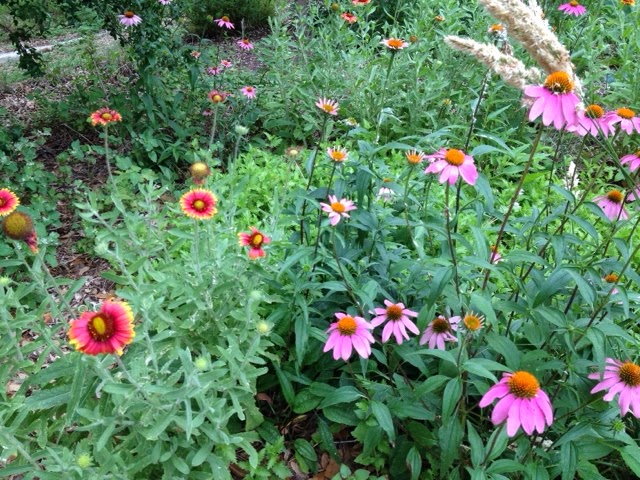
The purple coneflowers, Echinacea purpurea, and firewheel, Gaillardia pulchella, are beginning to show their stuff. 

I've collected and spread seeds from the Echinacea all over the garden over the years, so it has become rather prolific. Purple coneflower is beautiful, relatively shade tolerant, and a great butterfly nectar plant.


Firewheel might be one of our most under-rated native spring bloomers. Everyone goes nuts for the bluebonnets, which I love too, but big fields of firewheel are pretty darn amazing.

21 April 2014

Spring in the Pocket Prairie


This is the second growing season for some of the plants in our tiny front yard pocket prairie. Last year, we planted grasses like sideoats grama, little bluestem and blue grama.


We also planted firewheel, purple prairie clover, antelope horn seedlings, and standing cypress. Many of these are filling in and some are just about to bloom.


There are also some plants coming in that I can't yet ID. One might be a Black-eyed Susan. Remains to be seen. We did have some Rudbeckias out back several years ago that never took. Perhaps this is seeded from that - with some delay.


It's a stretch to call this a pocket prairie. Prairies are large complex grass-dominant ecosystems. This is just a wild planting using some prairie plants. It's our one little spot of sun, and I'm using it more like an experimental plot than anything. Just seeing what makes it.

Here's a gratuitous shot from the other side of the world, deep in the shady part of the garden.

08 April 2014

Texas Blue Grass

I have a small stand of Texas blue grass, Poa arachnifera, and it is just amazing right now. If I wasn't such a fan of biodiversity, I'd plant my whole yard in this grass. It is a cool season grass, remaining green all winter, only to shoot up these fantastic fuzzy, soft flower heads that wave in the breeze.


22 March 2014

Red Columbine


I love it every spring when my small bunch of red columbines, Aquilegia canadensis, blooms. 

These are volunteers from who know where, and they decided to grow hugged up against the corner of the house far out of regular view. They thrive in alkaline soil, so perhaps they benefit from the cement skirting around the base of the house?

I've been tempted to transplant these to someplace I want them, but always decide they are better off where they want to be. And it doesn't take much effort for me to visit with them in their place anyway.

25 February 2014

Transition to Spring

Things have begun their transition to spring here in Austin. Mexican plums blooming. Ageritas perfuming the air.

Here's a possumhaw full of winter berries with new leaves peaking through.


Bluebonnet rosettes and verbena greening up this planting with lovely tan winter grasses in the background.


Golden groundsel beginning it's show in the understory before the trees leaf out.


Carolina jessamine glowing yellow.


A wonderful time full of anticipation!

(All photos taken at the Wildflower Center.)

27 November 2013

Little Bluestem Glows Red

Bodi hanging in the nascent meadow.

The little bluestems in said meadow have turned a gorgeous rusty red for the winter and are sporting fluffy white seed heads that shimmer in the winter sun.


The plants are small - they have only been in the ground for one season, after all - but they are just what I was hoping for.


Some of our more typical ornamental grasses, such as the muhlies, certainly are more symmetrical, but you just can't beat the rad red color of these native bluestems. And they ar of great benefit for native wildlife, including a big diversity of lepidopterans, including the Ottoe Skipper, Indian Skipper, Crossline Skipper, Dusted Skipper, Cobweb butterfly, and Dixie skipper.

Can't wait until they get bigger! 

They beat the hell out of Mexican feathergrass in this garden...

27 October 2013

Gayfeather and Goldenrod


The only gayfeather (Liatris sp.) in the garden is blooming bright purple-pink this week. It's a beautiful plant and would look amazing en masse. Above you can see it is in a mixed prairie-esque planting with standing cypress, giant coneflower, blue grama, sideoats grama and little bluestem. This is a new planting so all of the plants are only in their first year, aside from the Liatris and giant coneflower (which strangely doesn't bloom, but the big gray-green leaves are quite nice anyway).

Our side hedge is really filling in and the tall spreading goldenrod is always pretty this time of year.


After years and years, thesw the big Lindheimer muhlies are finally blooming in full force. 


These are native to the Edwards plateau more than the blackland, but they are a beautiful landscape grass around these parts anyway.

12 October 2013

More Happy Plants


As I sit here typing this, the rain continues to come down out there. We had four inches (four inches!!) so far last night and it doesn't look to be letting up anytime soon. Thank goodness I went to ACL Fest last weekend instead of this one...

Lantana is a relatively "common" plant, but isn't it so beautiful in bloom?


I planted to frog fruit this year up front, just a few plants to see how they would do. This is a very lovely, non-showy native that forms a nice, spreading ground cover in the natural area by our house. Butterflies love the tiny white flowers. It seems to be doing well.

Zexmenia is another really solid, constant bloomer around these parts. Here is it with the agaves. Speaking of, I'm going to be removing these agaves this year. They provided very important structure when we were just starteing the garden, but now they are mostly a nuisance.

Rock rose, mist flower, and four nerve daisy...

Everything is blooming. Thank you rain!

By the way, keep an eye out for the monarchs. They are starting to migrate through albeit at very small numbers so far. I've also seen a few snout butterflies on the move.