Showing posts with label native plants. Show all posts

26 November 2015

Thanksgiving Tree

Who needs a Christmas tree when you can have a Thanksgiving tree? 

I'm so thrilled to welcome a new chinquapin oak to our back garden, which replaces the xylosma that I removed a few weeks ago. The oak is perfect, and I can't wait for it to grow larger and provide us with shade from the hot summer sun.

Oaks are some of our most important trees for wildlife. They are hosts for tons of species of bugs, which means they are great sources of food for birds. The acorns are important for a lot of species too, such as blue jays. Even early settlers and Native Americans ground the acorns into flour. 

Great trees.

An added bonus is that this tree already looks like it belongs here in our deep black clay, near our creek that's in the Colorado River watershed. The xylosma never did. Something about it just seemed out of place, even though it was a nice specimen of a tree. The chinquapin looks at home. 

I'm thankful for this tree. Yes indeedy.


08 June 2014

When American Germander Takes Over


The American germander is starting to bloom with gorgeous repetitive whitish pink flower spikes.

This plant is taking over the front corner of the front garden, an is threatening to take over the entire garden.


I'm too busy (ahem, lazy) to keep it in check, so what will? Well, eventually something will, I'm sure of it. Perhaps some other plant (goldenrod) will start competing with it, or the ash tree will die or we'll cut it down and it'll be too sunny. Or it won't be moist enough for it (we don't water it and it likes moisture, so it's happy this year).


Above is the view of the germander creeping into the main garden space from the edge, starting to crowd into the sedge. There's a datura poking out from the germander mass, too.

10 May 2014

Coneflowers and Firewheel

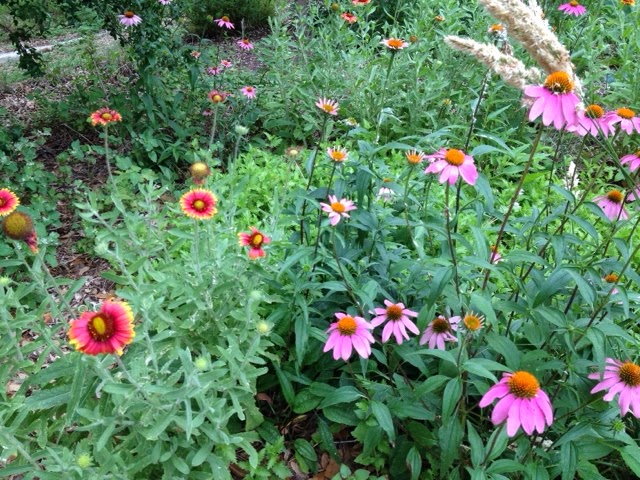
The purple coneflowers, Echinacea purpurea, and firewheel, Gaillardia pulchella, are beginning to show their stuff. 

I've collected and spread seeds from the Echinacea all over the garden over the years, so it has become rather prolific. Purple coneflower is beautiful, relatively shade tolerant, and a great butterfly nectar plant.


Firewheel might be one of our most under-rated native spring bloomers. Everyone goes nuts for the bluebonnets, which I love too, but big fields of firewheel are pretty darn amazing.

21 April 2014

Spring in the Pocket Prairie


This is the second growing season for some of the plants in our tiny front yard pocket prairie. Last year, we planted grasses like sideoats grama, little bluestem and blue grama.


We also planted firewheel, purple prairie clover, antelope horn seedlings, and standing cypress. Many of these are filling in and some are just about to bloom.


There are also some plants coming in that I can't yet ID. One might be a Black-eyed Susan. Remains to be seen. We did have some Rudbeckias out back several years ago that never took. Perhaps this is seeded from that - with some delay.


It's a stretch to call this a pocket prairie. Prairies are large complex grass-dominant ecosystems. This is just a wild planting using some prairie plants. It's our one little spot of sun, and I'm using it more like an experimental plot than anything. Just seeing what makes it.

Here's a gratuitous shot from the other side of the world, deep in the shady part of the garden.

05 February 2014

Is My Garden Native Enough?

Over the past few months, I’ve been getting freaked out that my garden doesn’t have “enough” native plants. I’ve been looking around and all I can see are non-natives that were either planted before I arrived, or in fact, were planted by me. The latter in particular have been making me feel embarrassed or irresponsible somehow. But let it be known that I too fall prey to that urge at the garden center to pick up random plants that look nice or captivating in some way.

For those of you who’ve been following the blog for a while, you know that I feel very strongly that I ought to use plants native to this region. This is important to me for a number of reasons, including supporting our struggling native wildlife. As Doug Tallamy points out in “Bringing Nature Home,” native plants support native bugs which support native frogs, birds, lizards, and ultimately, humans. Of course there’s also potential reduced maintenance, water use, sense of place, and many more reasons.

Collecting Data. Because Science.

OK, so back to freaking out and judging myself, neither of which are healthy are they? Before I began spontaneously ripping out all of our non-natives, beating like tell-tale hearts in my imagination, I decided to get more scientific about it. I wanted to find out if my garden really is heavily focused on non-natives, or if I was just perceiving that. So, I collected some data. I made a list of most of the plant species in the garden and classified them as:
  • Blackland prairie native. My garden sits closest to where this historic ecosystem used to be. We have deep black clay soils. Plant examples include little bluestem and giant coneflower.
  • Central Texas native. Austin sits at the convergence of several ecosystems, and plants clearly move back and forth among them over time. We aren’t far away from the Balcones escarpment, which is drastically different habitat. Blackland plants would also be considered “Central Texas natives,” but for my counting purposes, I’ve only given them one label. These plants are more Edward's Plateau-related and include cenizo and flame acanthus.
  • American native. These plants fall outside of Central Texas, but are native to Texas or other parts of the U.S. This includes plants like Arizona ash and bamboo muhly.
  • Non-native. These are just plain not native to anywhere in the U.S. Think: xylosma and Greek oregano.
Here’s my mostly full list of plants. (Caveat: I have not verified fully the exact native ranges of these species, and some of them, such as the Carex retroflexa var. texensis are cultivars, which complicates things.)

Here’s a little graph showing what I found:


And here’s what I happily learned from the above analysis:

Actually, Blackland prairie and Central Texas plants dominate my garden in terms of species richness. (Species richness is a simple count of how many species are in a defined region; in this case, my yard.) At the Grackle, we have 93 different species of plants total, 70 percent of which are native to this general area.

Species richness is distinct from species diversity, which takes into account things like relative abundance. If I were looking at diversity, for example, I would need to take into account that my garden has more than 50 individuals of Carex retroflexa and more than 12 Yucca pallida. There’s only one big giant Arizona ash.

Honey I Shrunk The Plants

Bottom line, I guess, is that sometimes what I see everyday, like the Arizona ash, the loquats and the xylosma, dominate my perception because they are, put simply, big. In reality, the overall garden is quite a bit more diverse.

But importantly, the way I see the garden may be how certain other species are perceiving my garden too. Perhaps some of the birds and bugs only “see” the giant ash and xylosma, of which they cannot utilize not at all. They fly through and don’t perceive much useful to them aside from a branch to perch on (which, come to think of it, has value too).

Ultimately, wouldn’t it be better if that Arizona ash were a tall sycamore or common persimmon? Or if those loquats were Texas persimmons and yaupons? Taken to a further extreme, that those bamboo muhlies were instead Indian grass?

Well, in fact, the answer is - for me - YES, but the reality can be quite different. It costs money and time to buy new plants and nuture them. It takes water, too. Some of these non-native plants provide other services, such as much needed shade (or a nesting or perching place). And then, it’s hard to draw the line. What exactly is native? How far away does it need to be from my house to be native? And really, who wants to be so dogmatic anyway?

It's For the Birds

Perhaps this is all to say that I still think it’s important for me to think about plant choices very carefully before committing to them. And it reinforces my wish that nurseries and home centers should not be stocking these species that have no place, no meaning, no purpose other than being pretty. Ultimately though, it’s really my responsibility as a consumer. If we all stopped buying nandina from Home Depot, they’d stop carrying it.

So, back to my decision making. My goal is to try to replace the non-natives as I can. I’m not going to do any major plant-ectomies at this point, but I plan to over time, strategically. And I definitely want to be more conscious of my decision-making at the nursery than I already am. I don’t want to drive myself nuts, but I want to be responsible.

Because mainly, I want to help the butterflies, bees, birds, lizards and snakes. They need it.

27 November 2013

Little Bluestem Glows Red

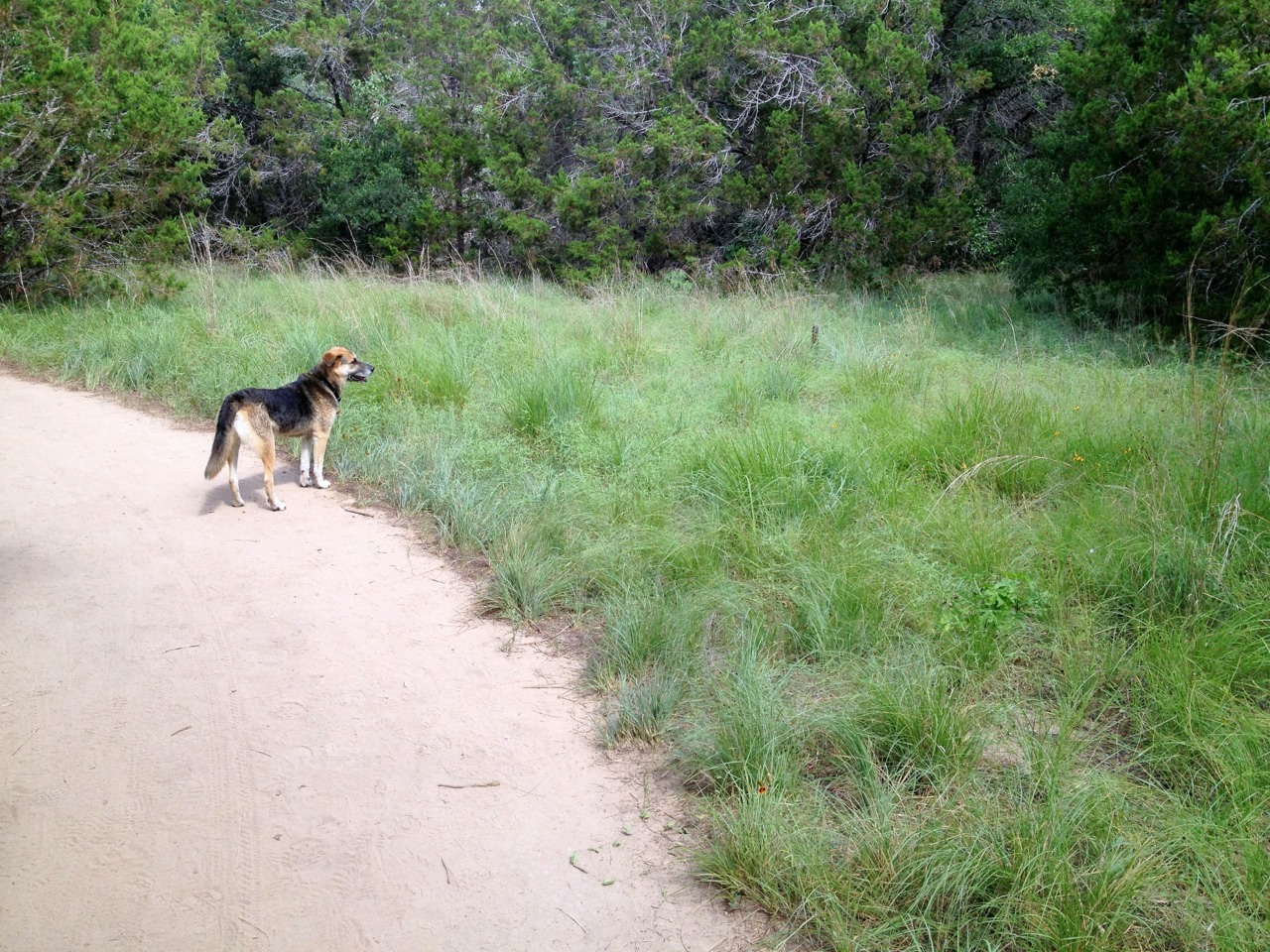
Bodi hanging in the nascent meadow.

The little bluestems in said meadow have turned a gorgeous rusty red for the winter and are sporting fluffy white seed heads that shimmer in the winter sun.


The plants are small - they have only been in the ground for one season, after all - but they are just what I was hoping for.


Some of our more typical ornamental grasses, such as the muhlies, certainly are more symmetrical, but you just can't beat the rad red color of these native bluestems. And they ar of great benefit for native wildlife, including a big diversity of lepidopterans, including the Ottoe Skipper, Indian Skipper, Crossline Skipper, Dusted Skipper, Cobweb butterfly, and Dixie skipper.

Can't wait until they get bigger! 

They beat the hell out of Mexican feathergrass in this garden...

07 October 2013

Fall Blooms & Berries

The fall light, slightly cooler temps, and small booster rainstorms are causing blooms to burst all around Austin. It's very pretty out there right now. I planted a few of these pink variegated Gregg's salvias last year (above) and they finally decided to start blooming. 

Below, evidence that our garden is merely steps away from becoming Grey Gardens. If you come by sometime and can't find the house beneath all the growth, just shout our names until you find us in the mass. 

Barbados cherries are flush with blooms. Lovely!

And of course, now is the time for beautyberries to begin to shine. I'm loving this combo of beautyberry and Turks cap just outside our bedroom window.

22 September 2013

Goodbye Desert Willow, Hello Grill Throne

Though it was with a twinge of sadness, the time came this weekend to remove the desert willow. See that whispy tree behind the bench?


I loved that desert willow - its pink blooms and the unique scent of its leaves. But I also didn't love it. There were times in its 7-year life in our garden that it was a lovely ornamental tree. But too often it looked like this, all scraggly twigs and thin leaves:


The desert willow (Chilopsis linearis) is a Texas native that naturally occurs out west. The same goes for the feather grass that was planted beneath it, and I've also used that extensively in the garden. I've found that both of those species don't do very well in my garden's soil and light regimes. The Mexican feather grass always looks like crystal meth hair, all limp and matted. Not the wavy gorgeous feather grass of the open sunny Westside gardens.


Well, things have changed a bit at the Grackle. The plants are changing. Some of them that were doing wonderfully just aren't anymore. And some that used to be small, like the xylosma, are becoming quite large.

And sometimes, practicality must overrule design: we needed a place for our new Weber grill. I was sick and tired of going out to the driveway to use the old grill, and tired of the way it looked sitting out there by the cars.

So we said goodbye to the desert willow on this fall equinox, thanking it for all the good times.

In its place, we have created the grill throne.


Now, I actually can't believe that I ripped out a tree (practically a native) to put in a grill. That just seems like heresy, on a certain level. But on another hand, it sure was nice to grill some burgers there tonight. And there is a new simplicity that may be emerging in the back patio zone.

This probably isn't the final design, but it's a start. 


Next steps may include planting a coral honeysuckle vine on the wood slat screen behind the grill, and maybe, if budget allows, moving the steel edging back a bit and expanding the pea gravel patio. That being said, for a guy of my height, the grill being 3-4inches taller is purty nice.

I'm also going to start planting different plants under the xylosma, which has created quite a shady spot. Perhaps I'll move away from several different species and head toward more of a mass planting of something - more sea oats or some other shade tolerant native.

Anyhoo, out with the old in the with the new. Sniff.

08 September 2013

Eryngo


Speaking of eryngo, here's a lovely Central Texas native with a very happy bee.

05 August 2013

Native Prairie Plants in Midwestern Gardens

A handful of native prairie plants are fairly commonly used in formal gardens in Wisconsin. I'd say that bee balm (Monarda), purple coneflower (Echinacea), black eyed Susan (Rudbeckia) and gayfeather (Liatris) are the most common. 


Here's a nice Culvers root:


And there are quite a few people that embrace the pocket prairie concept. Here's a nice version of that planted on a backyard berm that is very diverse in prairie perennials such as those mentioned above, plus rattlesnake master, pale coneflower, gray headed coneflower and more.


This planting lacks grasses, which are typically more dominant in actual prairie, but its a gorgeous combination of flowering perennials and was buzzing with bees and will be a treat for hungry birds in fall and winter if left unmown.


01 July 2013

Mothering Milkweeds for Monarchs

Asclepias tuberosa, or "butterfly weed," growing in Wisconsin.
In my opinion, native milkweeds (Asclepias) are completely underutilized in the gardens of Texas. We have several species that are just beautiful plants, including Antelope horns, green milkweed, swamp milkweed, butterfly weed, and milkweed vine. Here's a list of milkweeds for Central Texas. Here's another one. And another.

In the Midwest, butterfly weed, Asclepias tuberosa, is actually pretty widely used in garden. It is a prairie milkweed that is native all the way down to Texas. It's bright orange flowers (pictured above) and mounding form are perfect for flower gardens. And though butterfly weed is native to Texas, I rarely see it used here, or even growing anywhere on the roadside.

The one exception I've seen anywhere is actually right around the corner from me, where enterprising neighbors have a small patch of A. tuberosa they planted a few years ago. Here's a photo of one of them:

Antelope horns, Asclepias aperula, is a prime candidate for flower gardens, in terms of form. It requires very low water, has a beautiful mounding habit, gorgeous architectural flowers and very interesting horn-like seedpods that would look great in the winter garden.

Young A. asperula planted in our neighborhood flower garden. I think I got this transplant from the LBJ Wildflower Center years ago.


I've recently been learning why I don't see our native milkweeds in more gardens: they are extremely difficult to grow.

A couple of years ago, I bought some butterfly weed seeds from Native American Seed, and threw them in the ground. A couple actually sprouted and then they quickly died. I'm pretty sure it was snails.

Well, this year, I picked up one of NAM's new "Sustain the Migration" kits with three species of native milkweed seeds and everything you need to try to grow them. It all came in a nice package...

The most important thing to do, they say, is to cold stratify the seeds. This simulates winter, and loosens up the seed husk so the tiny plant embryos and break through and grow.

To cold stratify the seeds, I placed them in small ball jars with some vermiculite (in the package) and water and left them in the fridge for four weeks. (I'm trying to grow rattlesnake master too. It's another beautiful native that seems near impossible to grow.)

After four weeks, I planted the seeds in potting soil and put them outside. Watering them every day, they sprouted and grew to about 3 inches tall over a 4-6 week period.


But now it is put up or shut up time. It's hotter than hell out there, and the worst time to plant anything, but these little suckers had to get in the ground. I planted them today. I will try to baby them through the summer, and hope that the snails, heat, dryness, and whatever else out there doesn't get to them first.

Why all this fuss anyway? Well, as I've said, the milkweeds are beautiful, but they are also extremely important to monarch butterflies, which host exclusively on milkweeds.

And the monarchs, they need our help. As most folks know, monarchs migrate south to Mexico to overwinter in pine forests there. This year the monarch populations had a record low in Mexico (Though they do fluctuate. Check that out here.)
Monarchs migrating to Mexico roosting for the night in West Texas.

It's not clear exactly what is causing the decline in monarchs, as far as I can tell, but it is likely a number of things, from fire ants to climate change. There is a documented decrease in the milkweed. As more land is cleared and more herbicides are applied to roadsides and fields, the milkweed populations go down, and the monarch caterpillars then have fewer plants to grow on.

I've got a little personal mission to get more milkweed around these parts to help these incredible creatures out.

If you don't have the patience for all this milkweed mothering nonsense, but want to support monarchs, plant tropical milkweed. Asclepias curassavica is a native to Mexico that is widely planted around Texas, and it is a great host for butterflies. The monarchs and queens love it. It's a pretty and easy plant to grow, and available in most nurseries. It requires a good amount of water though, from my experience, so just beware of that. Also beware that it's often called "butterfly weed" in the nursery, but it isn't. That's A. tuberosa.

Here are a few links related to all this stuff that have more links for all your learning needs:

Milkweeds of Texas from the Texas Butterfly Ranch
Texas Monarch Watch
Milkweeds of Texas from Mike Quinn

In the meantime, I'm going to mother (or is it father?) my little weeds and hope for some growth and regrowth next spring...

25 June 2013

Midsummer Meadows

They say the solstice is the beginning of summer, but around here it feels like midsummer. And in fact, it is considered such in other cultures. Mostly it's the Europeans, but there is also the Festa Junina in Brazil.

In Midsummer meadows in Texas, the spring and early summer forbes are giving way to the grasses and late summer and fall forbes.

Going and gone are the firewheels, verbena, and of course bluebonnets and Indian blanket. Coming into strength are good prairie native grasses like sideoats grama, blue grama, little bluestem and switchgrass. Giant mounds of Maximilian sunflower are also beginning to dominate, though I don't show them in any of these photos.

Inspired by a number of garden designers, including Piet Oudolf and Christy Ten Eyck, I'm working on making a little meadow in my front yard too, one that is more dominated by grasses. I also want it to seem more planned and "clumped" rather than a full on naturalized meadow.

In spring, I planted small plugs of little bluestem and sideoats grama.

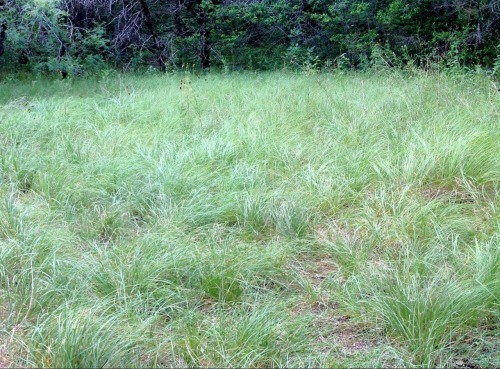
They will not amount to much yet this year, though some of the sideoats are throwing up bloom stalks, but I'm hoping for a nice late summer fall show in 2014.