23 November 2009

A new garden 'helper'

There is a big thing that's changed here at the Grackle that I haven't been able to bring myself to write about: we lost our sweet Libby. She was our beautiful creature, part-time gardener (many things in our garden reflect that it was designed to house a blind black lab inhabitant) and sometimes crazy companion. We miss her terribly, and will for some time.

We've had about a month now to heal a bit and both had become ever restless with the silence and lack of four paws prancing. So we recently began to look for another dog. There are just so many out there that need good homes. Places like P.A.W.S. in Kyle and Austin Pets Alive! are good places to find animals in need of good homes.

And this past weekend we met our newest crush when visiting Austin Pets Alive at Petsmart: Mr. Bodi.


I snapped this photo of Bodi patiently waiting for me as I toodled around the garden with a camera taking photos for this blog the other morning. What a sweet little guy! We're going through some "wait, this Bodi is nothing like Libby" adjustments at the moment, but I think we'll all emerge just fine. (I mean, it's really weird to have a dog that can watch what I'm doing!)

It feels a bit strange or sacrilegious or something to talk about Libby and Bodi in just one blog post, but I can't think of a different way to go about it.

And on another subject, I feel that I've been neglecting the garden a bit lately, and largely, they've been taking care of themselves with this milder weather. Translation: there are weeds EVERYWHERE! I'm going to be taking some time this holiday weekend being thankful for mulch, and thankful (or is it hopeful) that my hands won't get too sore from pulling weeds...

22 November 2009

Berries, fruits and buds

Fall is a time of berries, fruits and buds around Austin, not all of which are for us to eat. In fact, many of the plants bearing fruit now are for the resident winter and migratory birds.

The deep red berries of this hot and spicy chile pequin (Capsicum annuum) look great with a covering of morning dew.


The one-year old yaupons (Ilex vomitoria) have a pretty nice fruit set, despite the terrible drought.


Our new satsuma orange also made it through the drought and is bearing 4 fruits, almost ready for eating. I can't wait to taste them!


On the budding side of things, this is such a fun time of year. It's really exciting to sleuth through the garden and find new buds on plants waiting for spring and new seedlings (like black-eyed susans, columbine, etc.) sprouting forth waiting to grow big when it warms up again. This is the first year I've seen any flower buds on the Nolina texana, which is one of my favorite natives.


And this is just a nice little scene with the Echevaria, sedums, heartleaf skullcap and sedges.


A close-up on the contrast between the sedges Carex texana and the heartleaf skullcap (Scutellaria ovata).


I was worried that we'd lost the skullcap because it went away over the summer, but I guess that's normal. It comes back, is evergreen in the winter and will bloom in the spring. It's also spreading like mad (I think it's a mint), and will easily fill up the space it's in...and then some I imagine. But that's cool with me, for now. It's fuzzy gray leaves are so beautiful.

11 November 2009

B.I.M.B.Y.

For all folks living around Central Texas, I was just turned on to a great resource for identifying those fascinating six- and eight-legged critters flitting and rooting around in your gardens:

Entomologist Mike Quinn's web site B.I.M.B.Y. (Bugs In My Back Yard!).

Quinn is obviously the kind of guy who--opposite of the NIMBY attitude--actually wants bugs in his backyard. And we should too. Most of the time, anyway.

(Full disclosure: even a bug lover like me doesn't allow cockroaches, ants and termites into the house. They are fine out in the green world, but my built environment is mine and does not need to be composted and fertilized, thank you very much.)

Below are some cool bugs that you may find in your backyard, courtesy of B.I.M.B.Y.

The Aztec Spur-throat grasshopper (which I just posted about here):


The black banded or green stink bug:


The Southern flannel moth:


Anyway, the list goes on...cool resource for Central Texas gardeners interested in insects and spiders.

09 November 2009

Paper Wasp Mimic


This weekend, I found this beautiful insect lolling about on my basil. At first, I thought it was a paper wasp, but looking closely, I realized that it's a moth that is a paper wasp mimic. The clear give-away is the moth's long curled tongue that it uses to suck up nectar from flowers. It's antennae are also a bit longer than a wasp.


According to a 2005 report by Phil Schappert (PDF) who found this species in Bastrop, Texas, this day flying moth, Carmenta armasata (Sesiidae), is relatively rare in these parts. It's more typically found in South Texas. And it's a pretty darn good mimic of the paper wasp Polistes exclamans (photo below).


By mimicking such a wasp, the moth is surely protected from predators.

08 November 2009

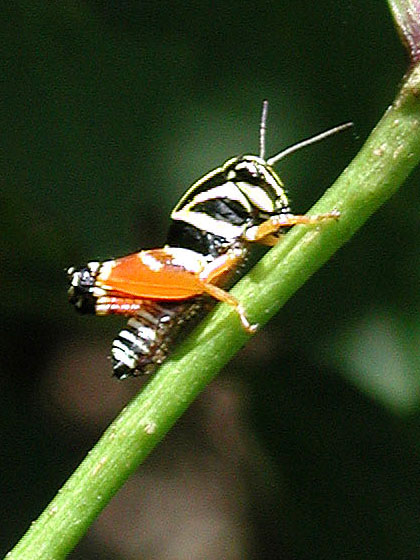
Culinary sage hit by nymph-omaniacs


So, throughout this droughty summer and now into fall, I've been watching this shrub of culinary sage get holier and holier (and no, I do not mean closer to god).


Turns out that this grasshopper nymphs have been enjoying the hell out of that sage, which actually is ok, since I have another more flavorful plant that I use for cooking anyway (and they don't seem to care for that one or haven't found it anyway).

They are really quite beautiful, even though these little critters can be quite the scourge!


There are several new flower buds on this sage. Strange late fall happenings in these parts...

07 November 2009

Coneflower Surprise


This surprise purple coneflower bloom is striking in contrast with the sprawling yellow of the "forsythia" sage (Salvia madrensis) that Renee from Renee's Roots donated to me last fall.

I'm really liking this large sage. It's form is very arching and architectural, too. And it looks to be spreading, now that the soil is a bit damper.

04 November 2009

Papel Picado


We were recently down in San Antonio for a couple of Dia de los Muertos celebrations, one of which was in Market Square.

I was inspired by the papel picado there, and have been enamored of these banners during previous visits to the city. Notably, last spring we walked around the King William district and many of the houses had papel picado on their porches, probably in preparation for Fiesta San Antonio week. It seemed so warm, fun and inviting to be there!


So, we picked up a strand of papel picado (actually, this is really "plastico" picado) and I've strung it up out back for the season. Papel picado is traditionally used for Dia de los Muertos, Christmas and Easter, so perhaps we'll keep this up through Christmas.


It certainly changes the feel back there and provides some splashes of color that'll be really great when things start turning wintery brown around here (when is that anyway? I love it here!).

02 November 2009

White Mistflower Madness

These following pictures are here to remind me that I need to get some white mistflower (Ageratina havanensis), also called shrubby boneset.

This one is blooming on campus, and aside from the wonderful floral scent, it is attracting an amazing diversity of pollinators, including many not pictured here that were camera shy.

Giant purple hairstreak:


The monarch butterflies are migrating through to Mexico:


American snout butterflies have been migrating by the thousands and thousands over the past couple of weeks. There was a humongous stream of them going through downtown just about 2 weeks ago. A sight to behold:

These butterflies go into huge migrations when there has been a drought followed by a drought-relieving rain. The caterpillars feed on hackberries and prefer tiny new leaves, which come out after rain. So, the population explodes and the migration happens...

A colorful moth:


And a non-colorful moth:


A neat little fly:


And the shrub was just bouncing with honey bees.