"...the persistent and often irrational desire to be surrounded only by those species of which one approves, and to exclude any animals, plants and other life forms that one finds offensive."She mostly speaks about animals--starlings and brown-headed cowbirds (hates 'em); eagles and goldfinches (loves 'em)--but I know gardeners can identify with her thesis (I know I can, on both the flora and fauna fronts).

30 April 2008
Biobigotry
What of those hateful hackberries and that grotesque garlic mustard? Natalie Angier, an amazing science writer for the NY Times, wrote yesterday about our "biobigotry," which she snarkily defines as:

28 April 2008
Caterpillars and Butterflies Galor
Last weekend, I was putzing about the garden and happened upon 3 black swallowtails in various stages of pupating. These butterflies are what some old-timers call "parsleyworm," due to the their obvious preference for growing up on fennel, dill, parsley, Queen Ann's lace and others in that family. These 3 all dispersed from the fennel, and thankfully they left plenty of that yummy herb/veggie for John and I to eat.

This is what the caterpillar looks like before it sheds its outer skin to reveal the alien-like chrysalis underneath. This one found a safe spot on the parsley.

Here's the same one in chrysalis form. Notice the small string of silk that cradles the top of the chrysalis. You have to wonder how they accomplish that. This one is green, but if it had chosen a brown stem, it'd be brown.

A different one found shelter in the sea oats.

And this little black swallowtail caterpillar snuck off to do its trick on the aster. (It was like finding jewels or Easter eggs, I tell ya...)

I caught one of the monarchs emerging.

This happened the same time of year that my mom was visiting last year. I supposed the first generation of monarchs will always remind me of her visit here...

And finally, anyone know what these critters are? These have totally devoured a sunflower and are moving to the others. They group together when smaller, but seem to be dispersing now. I'm not sure if they will get larger before pupating. Nor do I know why there are two different morphs (one blacker, one oranger).

This is what the caterpillar looks like before it sheds its outer skin to reveal the alien-like chrysalis underneath. This one found a safe spot on the parsley.

Here's the same one in chrysalis form. Notice the small string of silk that cradles the top of the chrysalis. You have to wonder how they accomplish that. This one is green, but if it had chosen a brown stem, it'd be brown.

A different one found shelter in the sea oats.

And this little black swallowtail caterpillar snuck off to do its trick on the aster. (It was like finding jewels or Easter eggs, I tell ya...)

I caught one of the monarchs emerging.

This happened the same time of year that my mom was visiting last year. I supposed the first generation of monarchs will always remind me of her visit here...

And finally, anyone know what these critters are? These have totally devoured a sunflower and are moving to the others. They group together when smaller, but seem to be dispersing now. I'm not sure if they will get larger before pupating. Nor do I know why there are two different morphs (one blacker, one oranger).
Label:
fauna
Squash Blossom

This is my first year planting summer squash in Texas, and I'm doing it--against most recommendations--in one of the raised beds. I planted two plants. The blossoms are gorgeous--just look at that deep orange-yellow. We've already harvested one squash and it was delish on a salad with roasted beets. Mmmm. I'm hoping we can get some more before the squash bugs find it, which may be soon...
Speaking of the beds, I'll have to photo them soon. The tomatoes are fixin' to take over, the watermelon vine is twisting its way about and the basil is almost already big enough for a batch of pesto (I love that!).
Label:
food
22 April 2008
The Yard Without Me
 Inspired by “The World Without Us,” a fantastic book by Alan Weisman, I thought I’d perform a little thought experiment myself.
In the book, Weisman wonders what the world would look like if all humans were to suddenly and completely disappear, not from some catastrophe that would generate its own damage (like nuclear war) but just quietly gone. Perhaps the Rapture would do it.
The book is meticulously researched, and the Houston chapter—outlining the everlasting effects of the petrochemical industry—scares the bejeezus out of me. But there are other little tidbits—like domestic cats are here forever, dogs won’t make it—that make the book extremely interesting.
So, here’s my experiment, admittedly with way less research than Weisman:
What would happen to my yard without me? (Um, I’ve seen a few neighbors who are carrying through with this thought experiment already).
For sure, the yard would become a thick forest of invasive ligustrum, non-native Arizona ash saplings, native hackberry and elms. Cedar waxwings would sit in our pecan and ash and poop the little ligustrum and hackberry seeds all over the place. I’m always pulling seedlings up from the lawn and beds. And every fall the Arizona ash sends forth a gazillion whirligigs all over the garden, into the street, down the gutters and throughout the Boggy Creek watershed.
I’ve seen a few Arizona ashes that’ve taken hold down at the creek. Whether or not they are the progeny of our tree is another story, since Arizona ash is/was widely planted around growing Austin as a quick shade, quick fix tree. (Subsequently, it’s a piece of crap, always breaking branches and never living very long.) In my yard, the ash seedlings form a green blanket across the garden beds, and if I weren’t there to pull them up, there’d be a forest of ash soon enough.
The understory, I think, would eventually stabilize with lots of inland sea oats, a native that’s a good spreader, and beautyberry, which is a nice shrubby thing with berries that seem to find their way all over the yard. Non-natives sure to elbow their way in would be the nandina from next door.
The widow’s tears (false dayflower) would quickly consume my raised veggie beds, and the horseherb would carpet the ground. After a while, as the wood rotted from the veggie beds, pecan trees and redbuds would begin to battle for that space, once given to making food for me and John. Eventually, of course, the pecans would reach for the sky, while the red buds would hang their heads and resolve themselves to work their magic in the shade.
Evidence of those rectangular beds would quickly disappear under the slimy feet of snails and the earthy smells of mushrooms.
The non-native ruellia (petunia) would easily take over the pea gravel patio, but perhaps some balance would form between it and the inland sea oats.
Virginia creeper would totally consume the garage and might just spread over everything. But, maybe there would be a nice bumper crop of hawkmoth caterpillars to keep the creeper in check. It sure would be a pretty red in the fall, but I guess I wouldn’t be around to appreciate it!
Of course, Bermuda grass, crab grass and St. Augustine would make a serious go of it. I’m guessing that they’d form a nasty tangle of grass in the beginning but eventually lose hold as they were shaded out by the ligustrums, ashes, hackberries and elms…I hope they’d lose. I hate those beasts.
You know, a live oak or two might make a stand, too. The squirrels and blue jays bury their seeds around the yard, and oak volunteers are not uncommon. I’m already trying to figure out what to do with two volunteers that have reached shrub size. One, I think I’ll leave as a future replacement for an older pecan tree.
I imagine the wildlife would change too, but I have less of a sense for that. Perhaps the greater number of mid-level saplings and small trees would increase bird diversity (right now it’s all high branches and low shrubs).
Okay, that’s enough of that. It’s a long post already. Nature is not stable, so I can’t predict a finished product, but I can bet that some dynamic balance will result in a new ecosystem around the yard.
Now, I best get back to pulling up that darned Bermuda grass...
Label:
living,
maintenance
21 April 2008
Peach Ooze and Daisies
Some color around the garden...

Engelmann's (cutleaf) daisy is a native of the blackland prairie. Seems pretty dependable thus far and I like the yellow and red...

The oranges and reds of the lantana look good with the purple/blue of the iris.


Engelmann's (cutleaf) daisy is a native of the blackland prairie. Seems pretty dependable thus far and I like the yellow and red...

The oranges and reds of the lantana look good with the purple/blue of the iris.
And for something completely different, this is what happens to the peaches. Ooze, ooze everywhere ooze. I'm guessing this is caused by some little critter that bores into them. Whatever it is, they destroy the peach crop--we've not had a peach from our tree yet.

Guerrilla Primrose

13 April 2008
Prickly Dreads

The prickly pears are making new pads now, lime green and shiny. Here's a close-up of a growing pad, which is actually an adapted stem. I love the crazy dreadlock-like growths on the new pads. These are "ephemeral leaves" and fall off as the pad matures. I think it's from these spots, called areoles, that the spines would also form (this is a spineless variety of opuntia).
On a non-gardening note, I was just checking out the line-up for ACL Fest this year. Beck, David Byrne, Antibalas, Neko Case, Band of Horses...it's going to rock!
On a non-gardening note, I was just checking out the line-up for ACL Fest this year. Beck, David Byrne, Antibalas, Neko Case, Band of Horses...it's going to rock!
Label:
fauna
Monarch Factory

Okay, so I'm obviously obsessed with monarch butterflies, but they are obviously obsessed with my tropical (red) milkweed, Asclepius lanceolata. As with last year, there are more monarch caterpillars on my two milkweed plants than I can count.

Two of them have already had their fill of the milkweed and are turning into adults. The monarchs feed exclusively on milkweed, sequestering the toxic chemicals in the plant. As adults, they advertise their noxiousness to birds with orange and black wings (it's no great secret why we also associate stop/danger with the colors red and orange).

UPDATE (4/21/08): I've found a total of 4 monarch chrysalises on the house (there may be more hidden amongst the plants). It's very interesting that both this year and last, the caterpillars have headed west-southwest from the plants and attached on the house. Hypothesis A: They always head west-southwest. Hypothesis B: They follow scent trails from caterpillars that have gone before them, and it's just chance that the first one headed west two years in a row.
Label:
fauna
08 April 2008
Shout Out + Blooms
First of all to all the garden bloggers that I met at the Spring Fling this past weekend: you rock! It was great to meet all of you. One million thanks to Pam and the organizers for putting such a seamless, perfect weekend together. I learned a lot; things like:

A freshly planted wine cup decided to make a go of it with a bloom.

Spiderwort (Tradescantia spp.)

Random irises left by the POs. I transplanted them without a care (no attention to depth or timing whatsoever). They decided I wasn't such a bastard after all and bloomed!

Native yellow columbine, Aquilegia chrysantha.

Gulf coast penstemon (Penstemon tenuis) starting to bloom.
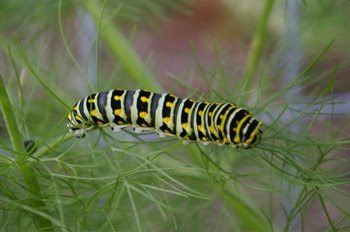
Fennel muncher = future swallowtail (the fennel and dill are hosting a handful of these critters).
- Tom Spencer is more than just a radio/TV program host. He's warm, intelligent and spiritual. I certainly never thought I'd get teary-eyed at the Circle C Nuevo Leon with a bunch o' gardeners, but Tom worked his magic!
- Mary Oliver is a poet worth reading.
- James David and his partner are fabulous and have an amazing garden + house.
- Garden bloggers are friendly, smart, funny and fun to be around.
- Related to above: I should do better reading all of their wonderful blogs.

A freshly planted wine cup decided to make a go of it with a bloom.

Spiderwort (Tradescantia spp.)

Random irises left by the POs. I transplanted them without a care (no attention to depth or timing whatsoever). They decided I wasn't such a bastard after all and bloomed!

Native yellow columbine, Aquilegia chrysantha.

Gulf coast penstemon (Penstemon tenuis) starting to bloom.

Fennel muncher = future swallowtail (the fennel and dill are hosting a handful of these critters).
02 April 2008

Subscribe to:
Posts (Atom)