
28 July 2006
If trees could walk
Our ability to move huge, mature trees is fascinating. Now, rather than cut a big old tree down, it seems that campus landscapers just dig 'em up and move 'em around. Not only does this save a tree, it creates an immediate "old" garden--a very new landscape that looks like it's been there for 50 years. Excellent. I wonder if birds nesting in the boughs move down the road with their tree?

27 July 2006
Take me to the river
The Brackenridge tract on the shores of the Colorado River just west of campus is up for review by the Board of Regents. The tract is currently home to the Brackenridge Field Lab, a golf course, some university housing and a grocery store. An article in the Statesman revealed that when Brackenridge donated that land (500 acres in 1910), he intended it to be used for the main campus of the university. The Regents chose to expand the 40 acres instead.
It's interesting to imagine what the university would be like if it had moved to the land along the river. The ecology and culture would be completely different. For example, imagine sipping a beer at the Texas Union on a porch overlooking the water. Or, perhaps using a long break between classes to check out a kayak and scoot around the water. Maybe there would've been a swimming dock? Or faculty would commute by canoe from West Lake Hills? Though I love the 40 acres as much as the next person, the Regents' decision, in my humble opinion, was a poor one, particularly in relation to campus culture and ecology.
How much does ecology, natural setting and design affect culture and community? Interesting question.
Updates: new articles in the Daily Texan
It's interesting to imagine what the university would be like if it had moved to the land along the river. The ecology and culture would be completely different. For example, imagine sipping a beer at the Texas Union on a porch overlooking the water. Or, perhaps using a long break between classes to check out a kayak and scoot around the water. Maybe there would've been a swimming dock? Or faculty would commute by canoe from West Lake Hills? Though I love the 40 acres as much as the next person, the Regents' decision, in my humble opinion, was a poor one, particularly in relation to campus culture and ecology.
How much does ecology, natural setting and design affect culture and community? Interesting question.
Updates: new articles in the Daily Texan
26 July 2006
Peter Walker's Garden: where the wild things are
 I've been admiring the Blanton Museum's landscaping from time to time over the last few months. (It's WAY more interesting than the exterior architecture.) Designed by Peter Walker Partners from Berkeley, CA, the landscape is very beautiful and different than other more common landscapes on campus. What I discovered yesterday was the wildflower meadow on the north side of the building. This rectangle of dense buffalo grass is a soft and woolly conterpoint to the blank wall of the museum. Three mature red oaks stand above a meadow which is currently filled with blooming wildflowers. I think I saw - among many - several varieties of horse mint, a phlox, winecup, and Mexican hat. Plus, this place was abuzz with grasshoppers and birds, a cacophany compared with the quiet lawns just 10 feet away. Very cool! I highly recommend a walk through this little oasis on campus. Plus, the rows of cedar elms are highly pleasing in a medidative, rhythmic way...
Go native!
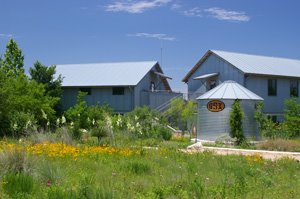
In my opinion, the Lady Bird Johnson Wildflower Center is one of the most amazing places to watch green things growing in the country. The Wildflower Center grows and advocates for native plants, participates in restoration research and landscape design (e.g. green roofs, xeriscaping, and diversity of roadsides), and the center itself is a beauty to behold. Lady Bird Johnson has left a fantastic legacy for this country and the world. Lucky for us, it's right here in Austin and the center will join the College of Natural Sciences and School of Architecture this fall. The potential is huge (and just maybe I'll be lucky enough to have more excuses to visit and learn).
Read more here>>
UT Austin campus ecology
I've created this blog as a place to chat with myself and anyone else who will listen about the ecology in and around the campus of the University of Texas at Austin. I'm very interested in the ecology of urban systems, landscape design, native and sustainable landscaping and the interface between culture and landscape. I'm hoping to start a group of faculty, staff and students at UT who share the same interests - a Campus Ecology Group.


Subscribe to:
Posts (Atom)